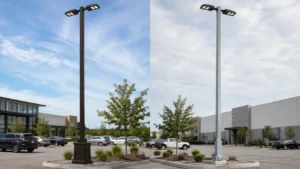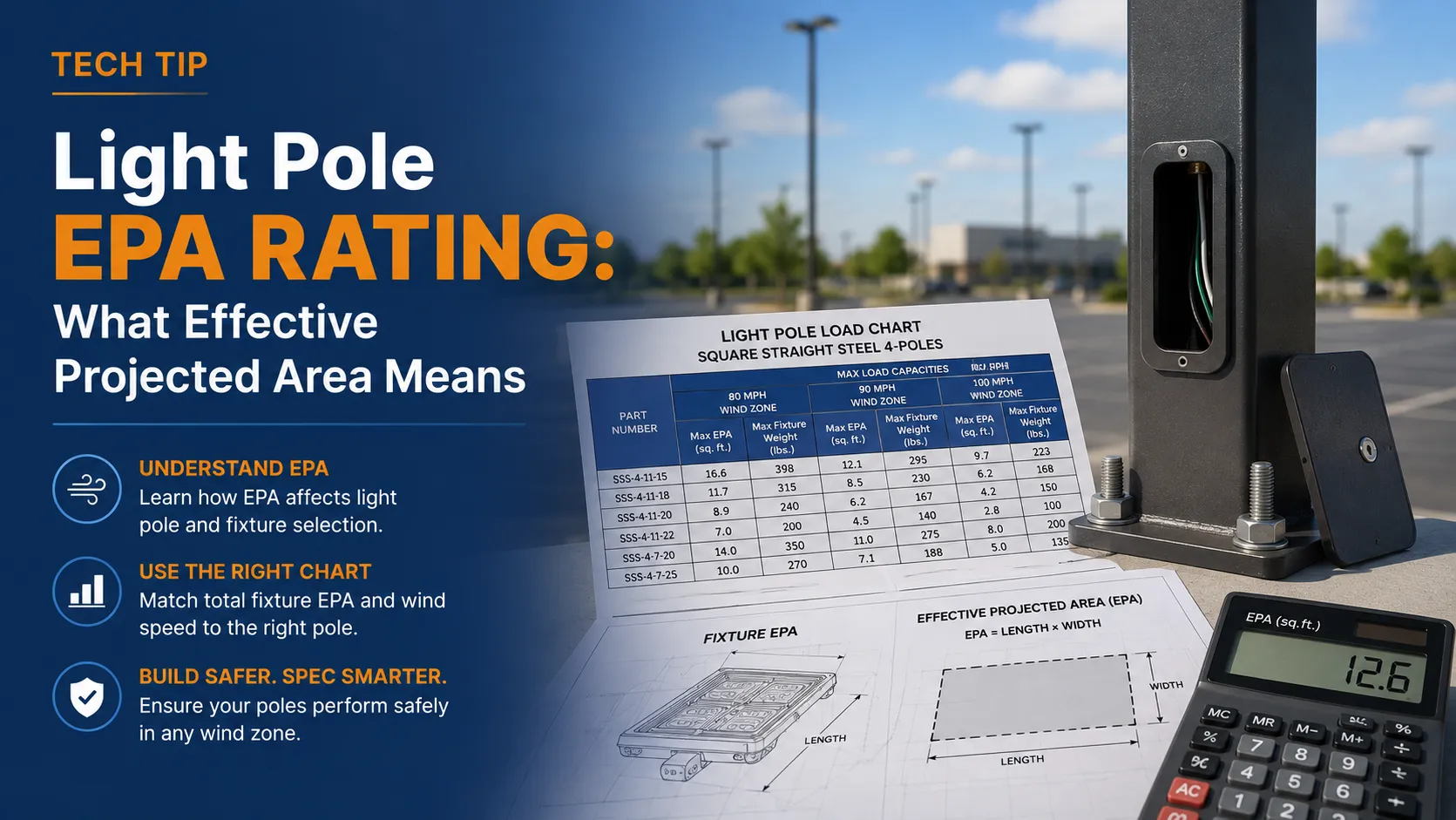
When selecting a light pole, height and fixture style are only part of the equation. The pole also needs to support the wind load created by the light fixtures, mounting arms, brackets, and other equipment attached to it.
That is where EPA, or Effective Projected Area, becomes important.
A light pole EPA rating helps determine whether a particular combination of pole, fixtures, mounting hardware, and site wind conditions is appropriate for an installation.
If you are replacing an existing pole, specifying a new pole, or comparing light pole load charts, understanding EPA can help you avoid selecting a pole that is not designed for the loads it may experience.
In this guide, we will explain what EPA means, how fixture EPA differs from a pole’s maximum EPA rating, how wind speed affects pole selection, and what information you should gather before choosing a light pole.
What Is EPA on a Light Pole?
In the light pole and outdoor lighting industry, EPA stands for Effective Projected Area.
In this context, EPA refers to Effective Projected Area, not the U.S. Environmental Protection Agency.
Effective Projected Area represents the wind-loading effect of an object mounted on a pole.
It takes into account the area of the object exposed to the wind along with its aerodynamic characteristics, represented by a drag coefficient.
In simplified terms:
Effective Projected Area = Projected Area × Drag Coefficient
This means two fixtures with similar physical dimensions do not necessarily have identical EPA values. Their shapes and how they interact with wind can affect their EPA.
Fixture manufacturers generally provide the EPA value for their products on the fixture specification sheet.
Why Does EPA Matter When Selecting a Light Pole?
A light fixture mounted at the top of a pole creates wind resistance.
As wind pushes against the fixture, mounting arm, brackets, signs, cameras, or other equipment attached to the pole, those forces are transferred into the pole structure.
The pole therefore needs to be capable of supporting both:
- The EPA created by the mounted equipment
- The actual weight of the mounted equipment
Wind conditions also matter.
A pole that can support a particular fixture configuration in one wind zone may not have the same allowable capacity in an area with higher design wind speeds.
This is why selecting a pole based only on height, shape, or appearance can create problems.
If you are new to pole construction and specifications, our guide to the different types of light poles provides additional background on pole materials, shapes, construction methods, and applications.
Fixture EPA vs. Maximum Light Pole EPA
One of the most important distinctions to understand is the difference between fixture EPA and maximum pole EPA.
Fixture EPA
Fixture EPA describes the Effective Projected Area of the fixture or other equipment mounted on the pole.
The manufacturer of the light fixture will typically provide this number on the product specification sheet.
If multiple fixtures or accessories are installed on the same pole, their EPA values must be considered together when determining the total load applied to the pole.
Maximum Pole EPA
A light pole’s maximum EPA rating tells you how much Effective Projected Area the pole is designed to support under specified conditions.
The allowable EPA is not necessarily one fixed number.
A pole manufacturer may provide different maximum EPA values depending on factors such as:
- Pole height
- Pole size
- Wall thickness or gauge
- Fixture weight
- Wind speed
- Pole material
- Pole configuration
- Applicable design criteria
This is why the same pole may show several different EPA ratings on a load chart.
Why Wind Speed Changes a Light Pole’s EPA Rating
As design wind speed increases, the allowable fixture EPA for a given pole generally decreases.
Consider a pole load chart that provides columns for:
- 80 MPH
- 90 MPH
- 100 MPH
The same pole may be capable of supporting a larger fixture EPA in the 80 MPH column than in the 100 MPH column.
That does not mean the fixture itself has changed.
The difference is the amount of wind loading the pole must be designed to withstand.
Higher wind speeds produce greater forces on the equipment attached to the pole. As a result, the allowable fixture loading must be reduced unless a stronger pole configuration is selected.
This is one reason it is important to know the project’s required design wind criteria before ordering a pole.
How to Determine the Total EPA of Your Fixtures
Start by reviewing the specification sheet for every item that will be mounted to the pole.
Depending on the installation, this can include:
- Light fixtures
- Mounting arms
- Brackets
- Bullhorns
- Cameras
- Signs
- Wireless equipment
- Other pole-mounted accessories
For an overview of common mounting configurations, see our guide to light pole fixture mounting options.
Record the EPA and weight of each applicable component.
For some simple fixture arrangements, the individual EPA values may be added together. However, the total combined EPA can change based on the number of fixtures, their mounting configuration, orientation, and tilt. Always use the fixture manufacturer’s published EPA data for the actual configuration when available.
Simple EPA Example
Suppose a project uses two fixtures and the manufacturer’s specification sheet lists each fixture with an EPA of:
2.0 sq. ft.
For a simple configuration where the manufacturer permits the individual EPA values to be added, the two fixtures would contribute:
2.0 + 2.0 = 4.0 sq. ft. total fixture EPA
You would then compare the required fixture configuration against the light pole manufacturer’s load chart for the applicable design conditions.
However, do not stop at EPA. The total fixture and accessory weight must also remain within the pole manufacturer’s allowable limits.
Fixture Configuration and Tilt Can Change Total EPA
For more complicated fixture configurations, refer to the fixture manufacturer’s specification sheet for the total combined EPA rather than simply adding the individual fixture EPA values.
When more than two fixtures are mounted on a pole, the combined EPA can sometimes be less than the sum of the individual fixture EPA values because one fixture may partially shield another from the wind. This effect is commonly referred to as wind shadow.

The example above shows how the EPA can vary depending on whether fixtures are mounted as a single fixture, two fixtures at 90° or 180°, three fixtures, or four fixtures. The mounting arrangement matters, so use the EPA value provided for the actual configuration whenever the fixture manufacturer supplies one.
You can also review our light pole fixture mounting options guide for examples of common fixture and mounting configurations.
Fixture Tilt Can Significantly Increase EPA
Fixture tilt is another important factor.
As a fixture is tilted upward, more of its surface area can be exposed to the wind. As a result, the EPA can increase substantially compared with the same fixture mounted horizontally.

The fixture manufacturer’s EPA chart should be reviewed for the actual fixture model, mounting configuration, number of fixtures, and tilt angle being used on the project.
If the required configuration is not shown on the specification sheet, confirm the applicable EPA with the fixture manufacturer or project design professional before selecting the pole.
How to Read a Light Pole EPA Load Chart
A typical light pole load chart may contain information such as:
- Part number
- Pole shape
- Pole size
- Wall thickness or gauge
- Pole height
- Maximum EPA
- Maximum fixture weight
- Wind speed
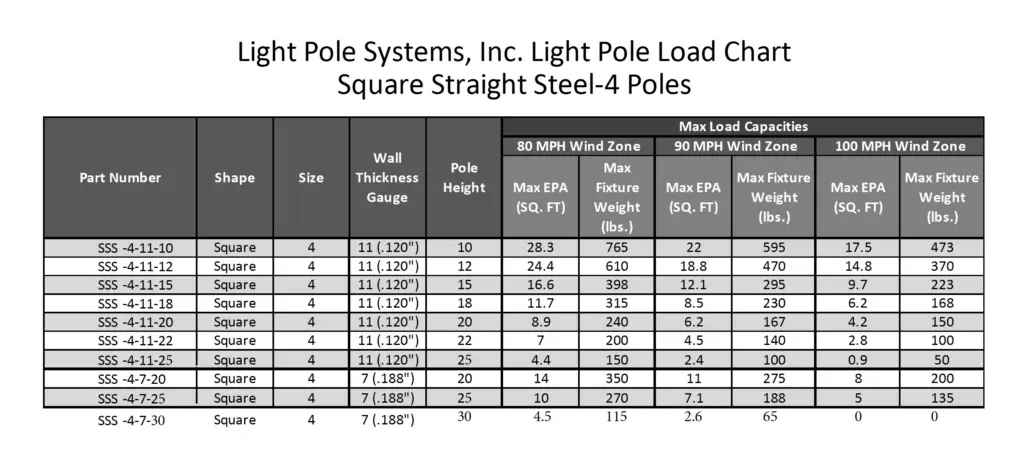
When reviewing the chart, work through the information in the following order.
1. Find the Correct Pole
Locate the row corresponding to the pole height, size, shape, and wall thickness being considered.
Do not assume two poles of the same height have the same load capacity.
Differences in material, diameter, shape, wall thickness, construction, and engineering can change the allowable loading.
You can learn more about pole construction in our guide explaining how steel light poles are made.
2. Find the Appropriate Wind-Speed Column
Next, locate the wind-speed or design-condition column applicable to the project.
For example, a load chart may provide different values for 80 MPH, 90 MPH, and 100 MPH conditions.
The applicable design criteria must be determined for the actual project location.
3. Compare the Total EPA
Compare the total EPA of the fixtures and applicable mounted equipment with the pole’s listed maximum EPA.
The total applicable EPA should not exceed the manufacturer’s maximum value for that pole and design condition.
4. Compare the Total Weight
EPA is only part of the selection process.
You must also compare the total weight of the fixtures and mounted equipment with the manufacturer’s maximum fixture-weight limitation.
A configuration can potentially satisfy the EPA requirement while exceeding the permitted weight.
Both need to be considered.
Example of Using an EPA Chart
Suppose your fixture configuration has a total EPA of:
5.0 sq. ft.
The pole load chart shows that the pole being considered has a maximum EPA of:
6.2 sq. ft.
under the applicable wind condition.
From an EPA standpoint alone:
5.0 sq. ft. fixture EPA < 6.2 sq. ft. maximum pole EPA
The configuration is within the stated EPA limit.
But you are not finished.
You must still verify the total fixture weight and any other requirements associated with that pole, installation, mounting configuration, applicable code, and project design.
If the required EPA or fixture weight exceeds the pole’s listed capacity, another pole configuration may be required.
Possible changes can include a different pole diameter, wall thickness, material, height, or engineered configuration.
How to Find Wind Information for Your Project
Wind requirements are location-specific.
A project in Southern California does not automatically have the same design criteria as a project in Florida, Texas, Arizona, or another part of the country.
The American Society of Civil Engineers provides the ASCE Hazard Tool, which can be used to look up site-specific hazard information, including wind data.
ASCE/SEI 7 includes criteria used for structural design loads, including wind loads. You can learn more about the current standard on the official ASCE/SEI 7-22 resource page.
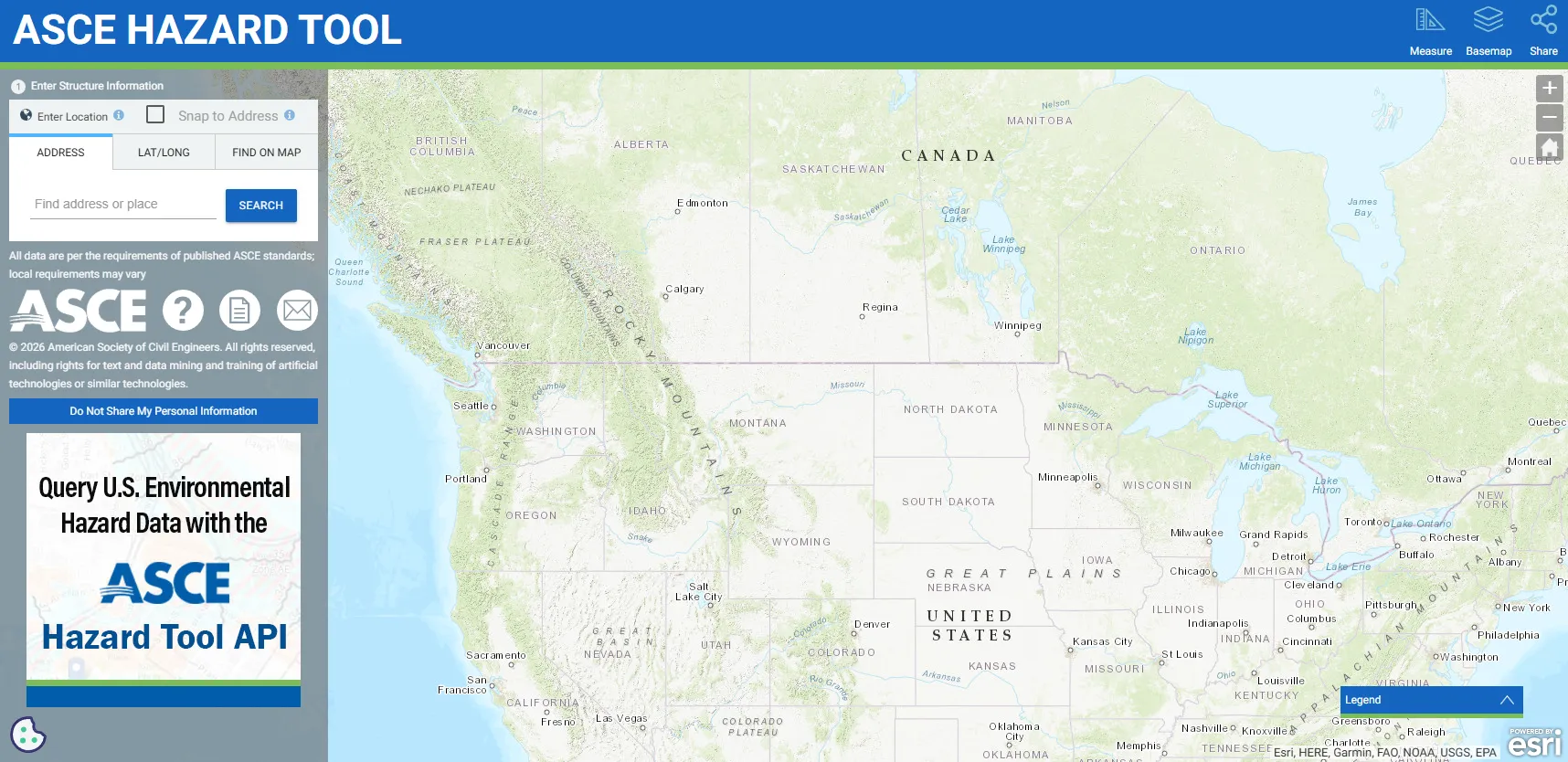
Using the ASCE Hazard Tool
The general process is:
- Open the ASCE Hazard Tool.
- Enter the project location.
- Select the applicable standard or edition required for the project.
- Select the appropriate Risk Category.
- Select Wind as the hazard.
- Review the resulting wind information for the project location.
- Use the applicable design information when evaluating the pole manufacturer’s load requirements.
Important: Do Not Automatically Select Risk Category I
The previous version of this article instructed users to select Risk Category I for parking lots.
We do not recommend using that as a universal rule.
The appropriate Risk Category, design standard, wind criteria, exposure conditions, and other requirements can depend on the project and governing building code.
Local jurisdictions may also adopt a particular edition of a building code or engineering standard.
When the required criteria are uncertain, consult the project’s engineer, architect, building official, or other qualified design professional.
EPA Is Not the Only Factor in Light Pole Selection
EPA is only one part of the information needed when specifying or ordering a light pole. Pole height, material, fixture mounting, anchor bolt configuration, finish, project location, and delivery requirements may also need to be considered.
If you are preparing for a new installation or replacing an existing pole, see our complete guide on how to order a light pole for the specifications and project information to gather before requesting a quote.
Other considerations may include:
Pole Height
Increasing pole height changes the structural loading of the system.
A taller pole generally experiences greater forces from equipment mounted at the top, which is why allowable EPA values frequently decrease as pole height increases.
Fixture and Accessory Weight
Fixtures, arms, brackets, cameras, signs, and other mounted equipment create static loads in addition to wind loads.
Review both EPA and weight.
Fixture Configuration
A single fixture, two fixtures mounted at 180 degrees, four fixtures on a bullhorn, or another arrangement can create different loading conditions.
Use the manufacturer’s data for the actual proposed configuration.
Pole Material and Construction
Steel and aluminum poles are available in many shapes, sizes, wall thicknesses, and structural configurations.
For projects requiring unusual dimensions or configurations, Light Pole Systems can also provide custom light poles for commercial and other specialized applications.
Local Design Requirements
The governing building code and project requirements should ultimately determine the design criteria used for pole selection.
A manufacturer’s EPA chart should be used with the conditions for which that chart was developed.
Common Light Pole EPA Mistakes
Several mistakes can create problems when specifying or ordering light poles.
Mistake 1: Looking Only at Fixture Weight
A fixture may be relatively lightweight but still have a significant EPA because of its size and shape.
Always check both weight and EPA.
Mistake 2: Looking Only at EPA
The opposite mistake happens too.
A fixture configuration may fall below the maximum EPA but exceed the manufacturer’s allowable fixture weight.
Again, both numbers matter.
Mistake 3: Using the Wrong Wind-Speed Column
Do not simply choose the lowest wind-speed column because it provides the highest allowable EPA.
Use the design requirements applicable to the project location.
Mistake 4: Ignoring Mounting Hardware
Arms, brackets, bullhorns, signs, cameras, and other accessories can add both wind area and weight.
If banners are part of the installation, see our guide to light pole banner wind load for additional EPA and safety considerations.
Make sure the complete configuration is considered.
Mistake 5: Assuming All Poles of the Same Height Are Equal
Two 20-foot poles can have very different structural capacities.
Pole diameter, shape, material, wall thickness, manufacturing method, base configuration, and engineering can all affect the allowable loading.
Mistake 6: Ordering Before Confirming Project Requirements
It is much easier to verify EPA, weight, wind criteria, bolt patterns, and other specifications before the pole arrives at the job site.
Verifying these specifications before ordering can help prevent costly compatibility problems, project delays, and the need to reorder a pole.
For additional problems worth checking before ordering a replacement pole, see our guide to common light pole problems and how to prevent them.
What Information Should You Gather Before Selecting a Light Pole?
Before requesting or ordering a pole, gather as much of the following information as possible:
- Project location
- Required mounting height
- Pole material
- Pole shape
- Fixture manufacturer and model
- Number of fixtures
- Fixture EPA
- Fixture weight
- Mounting arm or bracket information
- EPA and weight of other mounted equipment
- Required design wind criteria
- Applicable building code or engineering standard
- Anchor bolt configuration when replacing an existing pole
- Any special site or engineering requirements
Providing this information upfront can make it much easier to identify an appropriate pole configuration.
Light Pole EPA Frequently Asked Questions
What Does EPA Stand for on a Light Pole?
EPA stands for Effective Projected Area. It is used to represent the wind-loading effect of fixtures and other equipment mounted to a light pole.
Is EPA the Same as the Physical Size of a Fixture?
No. The physical projected area is part of the calculation, but EPA also accounts for aerodynamic drag. Two similarly sized fixtures can therefore have different EPA values.
Where Can I Find the EPA of a Light Fixture?
Look at the fixture manufacturer’s specification sheet.
EPA is commonly listed along with other fixture specifications such as dimensions, weight, electrical information, and mounting options.
If EPA is not provided, contact the fixture manufacturer for the appropriate loading information.
Does a Higher Wind Speed Reduce the Allowable EPA?
For a given pole configuration, higher design wind conditions generally result in a lower allowable fixture EPA because the pole must resist greater wind loading.
Always use the load data corresponding to the applicable project design conditions.
Can I Select a Pole Using EPA Alone?
No. Pole selection should also consider fixture weight, mounting height, pole construction, mounting configuration, applicable design criteria, and other project-specific requirements.
What Happens if My Fixture EPA Exceeds the Pole Rating?
Do not install a fixture configuration that exceeds the manufacturer’s specified loading limits.
A different pole configuration or engineered solution may be necessary.
Need Help Reviewing a Light Pole Application?
Understanding EPA is one part of selecting the correct light pole.
Pole height, fixture loading, wind requirements, base configuration, anchor bolt pattern, material, and other specifications also need to work together.
Light Pole Systems has decades of experience helping electrical contractors, distributors, facility professionals, municipalities, and other customers solve unusual light pole problems.
If you are trying to determine the right pole for a project, gather your fixture specifications, project location, mounting height, and available pole information and contact Light Pole Systems.
We can help you review the information and identify the next steps for your application.