When replacing a light pole or evaluating an existing concrete foundation, one of the most important measurements to confirm is the light pole bolt pattern.
A common source of confusion is the difference between a bolt circle and a bolt square. Both describe the position of anchor bolts, but they are measured differently. Mixing up the two measurements can result in ordering a replacement pole with a base plate that does not match the existing anchor bolts.
This guide explains how bolt patterns are measured, the difference between bolt circle and bolt square measurements, and what options may be available when an existing anchor bolt pattern does not match a replacement light pole.
Key Takeaways
- A light pole bolt pattern describes the spacing and arrangement of the anchor bolts in the foundation.
- Bolt circle and bolt square are two different ways of describing a four-bolt pattern.
- Measurements should generally be taken from the center of one anchor bolt to the center of another.
- Anchor bolt diameter should be recorded separately from the bolt pattern.
- Confirming the existing bolt pattern before ordering a replacement pole can help prevent compatibility problems.
- When a replacement pole does not match an existing foundation, an Anchor Bolt Adapter may provide another option in appropriate applications.
What Is a Light Pole Bolt Pattern?
A light pole bolt pattern describes the location and spacing of the anchor bolts installed in the concrete foundation.
These anchor bolts pass through the base plate of the light pole and secure the pole to the foundation. For a replacement pole to mount directly to an existing foundation, the new pole’s base plate must be compatible with the location of the existing anchor bolts.
That is why bolt pattern measurements are important when replacing damaged, corroded, outdated, or otherwise unsuitable light poles.
The bolt pattern is different from the actual diameter of the anchor bolts. If you also need to determine bolt diameter, see our guide on how to measure light pole anchor bolt size.
Bolt Circle vs. Bolt Square: What’s the Difference?
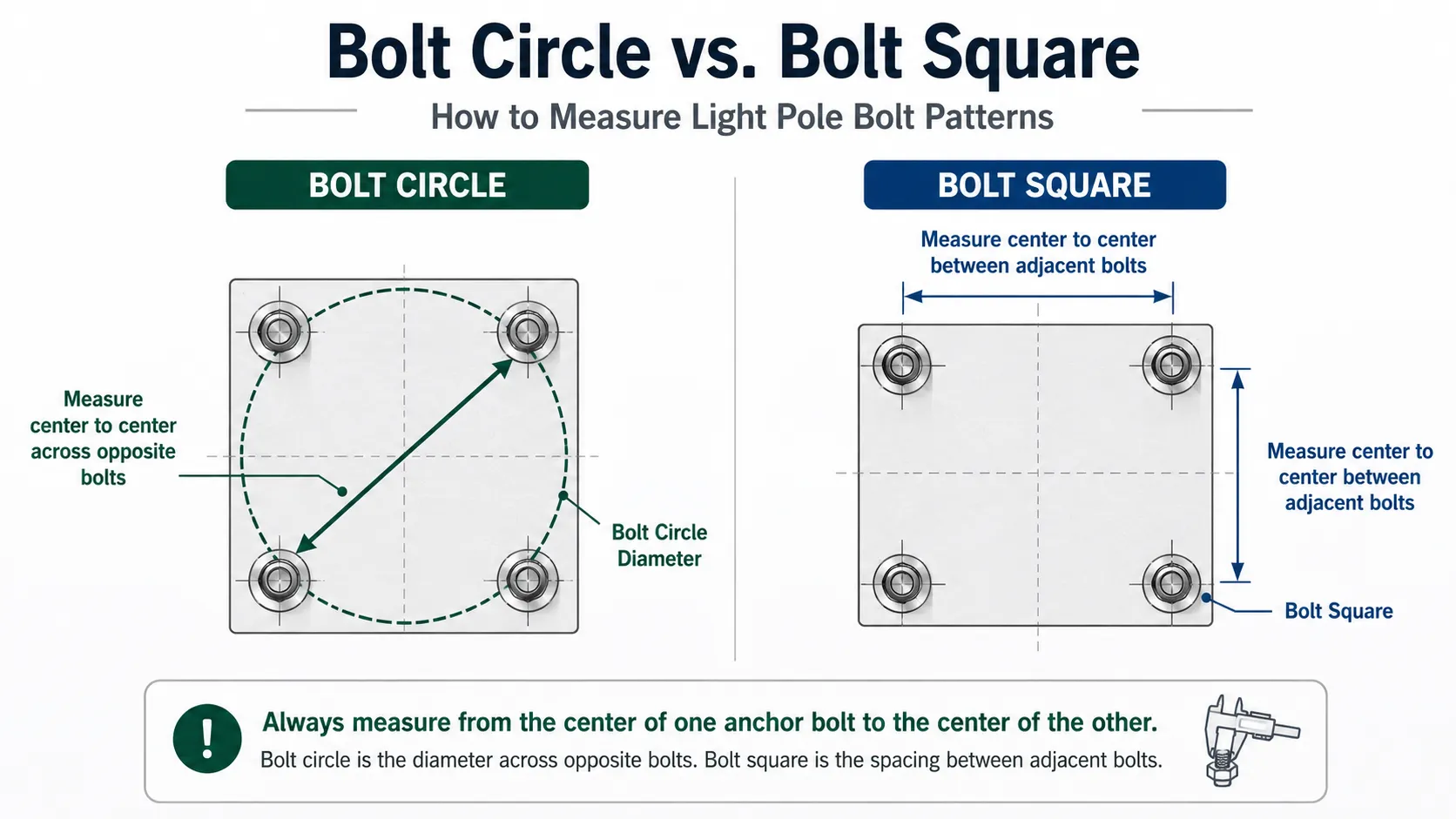
With a typical four-anchor-bolt configuration, the bolts may be described using either a bolt circle measurement or a bolt square measurement.
Although the two measurements describe the same group of anchor bolts, they are not the same dimension.
Understanding which measurement you have is essential when documenting an existing foundation or comparing it with the base plate dimensions of a replacement light pole.
What Is a Bolt Circle?
A bolt circle describes the diameter of an imaginary circle passing through the centers of the anchor bolts.
On a four-bolt square pattern, this measurement can be taken from the center of one anchor bolt to the center of the anchor bolt directly opposite it.
This represents the diameter of the bolt circle.
What Is a Bolt Square?
A bolt square measurement describes the distance from the center of one anchor bolt to the center of an adjacent anchor bolt.
If four anchor bolts are positioned at the corners of a square, the bolt square measurement represents the length of one side of that square.
Because the bolt circle runs diagonally across the square, the bolt circle dimension will be larger than the bolt square dimension.
Why Bolt Circle and Bolt Square Are Commonly Confused
Both measurements are taken from the same four anchor bolts, which makes it easy to record one dimension while assuming it represents the other.
For example, measuring from one anchor bolt to the adjacent bolt provides the bolt square dimension.
Measuring between opposing anchor bolts provides the bolt circle dimension on a four-bolt square configuration.
Whenever measurements are being submitted for a replacement light pole, make sure the measurement is clearly identified as either:
- Bolt Circle
- Bolt Square
Simply providing a number without identifying how it was measured can create unnecessary confusion.
How to Measure a Light Pole Bolt Pattern
Before measuring, make sure you can clearly identify the anchor bolts and determine their approximate centers.
For the most useful field measurements, record both the bolt pattern and the anchor bolt diameter.
Step 1: Identify the Anchor Bolts
Locate the anchor bolts securing the light pole base plate to the concrete foundation.
For a typical four-bolt pattern, identify all four anchor bolt locations before taking measurements.
If the existing light pole has already been removed, the anchor bolt locations should be easier to access and document.
Step 2: Measure Center to Center
Bolt pattern measurements should be taken from the center of one anchor bolt to the center of another anchor bolt.
Avoid measuring from the outside edge of one bolt to the outside edge of another. Edge-to-edge measurements can produce inaccurate dimensions, especially when the anchor bolt diameter is not taken into account.
Record the measurement carefully.

Step 3: Determine Whether You Are Measuring Bolt Square or Bolt Circle
For a four-bolt square configuration:
Adjacent bolt to adjacent bolt = Bolt Square
Opposing bolt to opposing bolt = Bolt Circle
Label the measurement when recording it.
Instead of writing:
Bolt pattern: 11″
Record:
Bolt Square: 11″
or:
Bolt Circle: 15.56″
Clear documentation makes it much easier to compare the existing foundation with replacement pole specifications.
Step 4: Measure the Anchor Bolt Diameter
The anchor bolt diameter is a separate measurement and should also be documented.
Do not assume the bolt pattern tells you the anchor bolt size.
If you are uncertain how to measure bolt diameter or are dealing with heavily galvanized or corroded bolts, review our detailed guide on measuring light pole anchor bolt size.
Step 5: Record the Complete Foundation Information
When evaluating an existing foundation, record as much information as possible before selecting a replacement pole.
Useful information may include:
- Number of anchor bolts
- Bolt circle measurement
- Bolt square measurement, when applicable
- Anchor bolt diameter
- Existing pole base plate dimensions
- Condition of the exposed anchor bolts
- If corrosion makes the existing nuts difficult to remove, see our guide to removing rusted anchor nuts from light pole anchor bolts.
- Photos of the existing pole base and foundation
Keeping this information together can help reduce mistakes when determining replacement options.
How to Convert Bolt Square to Bolt Circle
For a four-bolt square pattern, you can convert between bolt square and bolt circle using a 0.707 conversion factor.
Bolt Circle = Bolt Square ÷ 0.707
Bolt Square = Bolt Circle × 0.707
For example, if the bolt square measures 10 inches:
10 ÷ 0.707 = approximately 14.14 inches
The bolt circle would therefore be approximately 14.14 inches.
These calculations apply to a four-bolt pattern arranged as a square. Whenever possible, verify the actual anchor bolt locations and measurements in the field.
Watch: Measuring Bolt Patterns – Bolt Circle vs. Bolt Square
In this Light Pole Systems Tech Tip, we demonstrate the difference between bolt circle and bolt square measurements, how each measurement is taken, and how the two dimensions relate to one another.
The video is particularly useful when documenting an existing light pole foundation before ordering a replacement pole.
Why Accurate Bolt Pattern Measurements Matter
A replacement light pole base plate must work with the anchor bolt configuration at the installation location.
If the replacement pole and existing foundation have different bolt patterns, the base plate holes may not align with the existing anchor bolts.
Discovering this problem after the new pole arrives can result in:
- Installation delays
- Additional labor
- Unexpected project costs
- Rework
- Changes to the foundation or mounting system
- The need for an alternative replacement solution
Taking accurate measurements before ordering provides more information for evaluating compatibility.
Bolt pattern measurements can be especially important when the original pole manufacturer or original pole specifications are no longer available.
Bolt Pattern vs. Anchor Bolt Size
Bolt pattern and anchor bolt size are related, but they describe two different things.
Bolt pattern describes where the anchor bolts are positioned.
Anchor bolt size describes the diameter of the individual anchor bolt.
For example, an existing foundation could have a specific bolt circle while using 3/4-inch or 1-inch anchor bolts.
Both dimensions may be needed when evaluating replacement options.
For additional instructions, see How to Measure Light Pole Anchor Bolt Size.
Common Light Pole Bolt Pattern Measurement Mistakes
Accurate measurements are important, but several simple mistakes can create incorrect information.
Measuring Edge to Edge Instead of Center to Center
Bolt pattern dimensions are based on the centers of the anchor bolts.
Measuring from the outside edge of one bolt to the outside edge of another adds bolt diameter to the measurement and can produce the wrong bolt pattern.
Confusing Bolt Circle With Bolt Square
This is one of the most common sources of confusion.
On a four-bolt square configuration, measuring adjacent anchor bolts provides the bolt square dimension, while measuring opposing bolts provides the bolt circle.
Always label the measurement.
Confusing Bolt Diameter With Bolt Pattern
A 1-inch anchor bolt does not mean the foundation has a 1-inch bolt pattern.
The anchor bolt diameter and anchor bolt spacing are completely separate dimensions and should be recorded separately.
Ordering a Replacement Pole Before Verifying the Foundation
Whenever possible, document the existing foundation before ordering the replacement pole.
That gives you an opportunity to identify compatibility issues before equipment arrives at the jobsite.
What If the New Light Pole Doesn’t Match the Existing Bolt Pattern?
Replacing a light pole does not always mean the new pole will have the same base plate or anchor bolt configuration as the original pole.
This is especially common when:
- The original manufacturer is unknown
- The original pole is no longer available
- A different pole manufacturer is being used
- Existing foundations must remain in place
- Replacement pole specifications differ from the original installation
In certain applications, replacing the entire concrete foundation may not be necessary.
A Light Pole Anchor Bolt Adapter is designed to help accommodate differences between an existing anchor bolt pattern and the base plate pattern of a replacement pole.

The appropriate solution depends on the existing foundation, bolt pattern, replacement pole, engineering requirements, and project conditions.
For projects involving anchor bolts installed into an existing concrete foundation, you can also review our guide to installing anchor bolts in existing concrete.
Measure First, Then Evaluate the Replacement
The existing foundation is one of the first things that should be documented when planning a light pole replacement.
Before selecting a replacement pole:
- Identify the existing anchor bolts.
- Measure the bolt pattern center to center.
- Determine whether the measurement represents bolt circle or bolt square.
- Measure the anchor bolt diameter separately.
- Photograph and document the existing foundation.
- Compare the measurements with the replacement pole specifications.
If the new pole does not match the existing bolt configuration, evaluate the available options before modifying or replacing the foundation.
You can also review our guide to common light pole problems for additional information about issues encountered when evaluating existing light poles.
Need Help Matching a Replacement Light Pole to an Existing Foundation?
Every replacement project is different. Existing foundations, anchor bolt patterns, pole base plates, and field conditions can vary considerably.
Light Pole Systems specializes in helping contractors, facility departments, distributors, and other lighting professionals solve difficult light pole replacement problems.
If an existing anchor bolt pattern does not match the replacement pole you need, review the Light Pole Anchor Bolt Adapter to learn how the system works and whether it may be appropriate for your application.