How Steel Light Poles Are Made: From Flat Steel to a Finished Pole
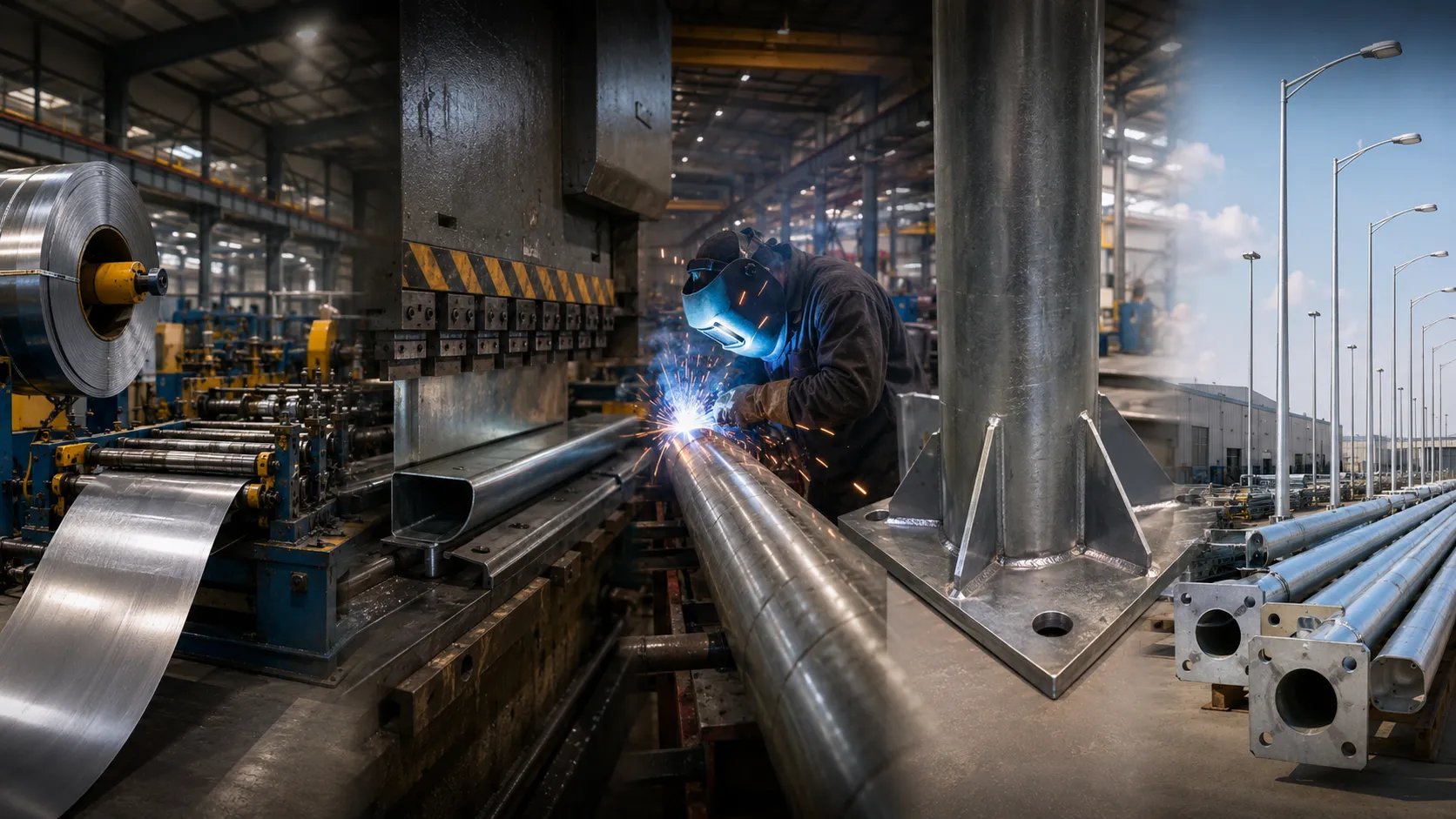
Have you ever wondered how a flat sheet of steel becomes a finished light pole?
Although steel light poles may look relatively simple, manufacturing one involves several steps, including forming the steel tube, welding, fabricating the base plate, cutting access and mounting holes, and applying a protective finish.
A typical steel light pole consists of two primary structural components:
- The vertical steel pole or tube
- The steel base plate used to anchor the pole to its concrete foundation
The light fixture is mounted at the top of the pole, while the base plate is secured to anchor bolts embedded in the concrete foundation.
Here’s a closer look at how steel light poles are manufactured.
Forming the Steel Pole
The process begins with flat steel.
Depending on the type of pole being manufactured and the production volume, the steel can be formed using different methods. Two common approaches are forming the pole with a press brake or using a cold roll-forming process.
Forming a Light Pole With a Press Brake
A press brake uses an upper tool and a matching lower die to bend a sheet of steel to a specific angle.
The steel is first cut to the proper length and width for the finished pole.
For example, a 10-foot-tall, 4-inch square pole begins as a flat piece of steel approximately 10 feet long and wide enough to form all four sides of the finished tube.
The steel blank is placed into a computer-controlled press brake and bent one section at a time until the desired pole shape is formed.
By changing the bending program and tooling, manufacturers can produce several pole configurations, including:
- Square poles
- Rectangular poles
- Octagonal poles
- Tapered poles
- Round poles
This flexibility makes press-brake forming useful when manufacturers need to produce different pole sizes and shapes.
Watch a Steel Pole Being Formed
After the steel has been formed, the open seam running along the pole is welded.
The weld can then be ground smooth to create a more uniform finished surface.
During forming and welding, the steel tube can sometimes develop a slight bend or distortion. When necessary, the pole can be supported at multiple points and carefully straightened with a press.
The same basic process can be adapted to manufacture different pole shapes by changing the number and angle of the bends.
For round poles, different tooling can be used to gradually form the flat steel into a cylindrical shape.
Round Steel Pole Manufacturing
Cold Roll-Forming Steel Light Poles
Cold roll forming is commonly used when producing larger quantities of steel tubing.
Unlike press-brake forming, where the shape can be changed relatively easily, a roll-forming line is typically configured for a particular tube profile.
The process begins with flat steel that has been cut to the required width.
The material passes through a series of rollers that progressively form the steel into the desired shape.
For a square tube, for example, the first rollers begin bending the outside edges of the steel. Additional rollers gradually create the corners until the sheet has been formed into the square tube.
Once the edges meet, the seam is automatically welded.
Excess material from the weld can be removed to create a smoother surface. The tube then continues through additional cleaning and finishing rollers to help maintain the required shape and dimensions.
Because the process is continuous, an automatic saw can cut the finished tubing into the specific lengths required for each light pole.
After the tube has been formed, additional fabrication can include cutting:
- Hand holes
- Fixture mounting holes
- Electrical access openings
- Other openings required for the specific pole configuration
For examples of common fixture configurations and mounting requirements, see our guide to light pole fixture mounting options.
The hand hole provides access to wiring and electrical connections inside the pole. In areas where copper theft or vandalism is a concern, a Universal Locking Hand Hole Cover can help secure this access point.
Manufacturing the Light Pole Base Plate
Compared with forming the pole itself, manufacturing the steel base plate is relatively straightforward.
Base plates are typically cut from heavy steel plate.
Depending on the manufacturer and application, the plate can be cut using equipment such as:
- CNC laser cutting systems
- Water jets
- Flame-cutting equipment
Multiple base plates can be produced from one large sheet or plate of steel, helping manufacturers use the material efficiently. Remaining steel can also be recycled for future steel products.
Once the base plate has been fabricated, it is positioned around the bottom of the pole.
The manufacturer checks that the pole and base plate are properly aligned before welding the plate to the tube.
Welds are typically made around the connection between the pole and the base plate. Depending on the pole design and structural requirements, additional gussets or reinforcement may also be added.
Once installed in the field, the base plate connects the pole to the anchor bolts embedded in the concrete foundation.
Finishing a Steel Light Pole
Because exposed steel is vulnerable to corrosion, a protective finish must be applied before the pole is placed into service.
Common finishing options include:
Paint
Painting is a common and economical way to finish a steel pole. It also makes it relatively easy to match the pole to a particular project or site color.
Powder Coating
Powder coating can provide a durable, high-quality finish. The coating is applied to the steel and then cured to create the finished surface.
Because light poles can be large, however, the equipment required to process an entire pole can make powder coating more involved than conventional painting.
Galvanizing
Galvanizing provides corrosion protection to the steel, including areas that may be difficult to reach with conventional painting.
This can be particularly important inside a steel light pole.
Moisture can sometimes become trapped inside a pole after installation. If the interior steel is left unprotected, that moisture can contribute to corrosion over time.
Because the galvanizing process can coat both exterior and accessible interior steel surfaces, it can provide more comprehensive corrosion protection than coatings applied only to the outside of the pole.
For a closer comparison of common pole finishes, see our guide to powder coated vs. galvanized light poles.
Why Steel Light Pole Construction Matters
From the outside, a steel light pole may appear to be little more than a piece of tubing attached to a base plate.
In reality, its manufacturing process involves carefully forming the steel, welding and straightening the tube, fabricating the base plate, creating the required access openings, and protecting the finished pole against corrosion.
Understanding how light poles are manufactured also makes it easier to understand why pole shape, base configuration, anchor bolt locations, access openings, coatings, and other specifications matter when maintaining, repairing, or replacing an existing pole.
If you are selecting a replacement or new pole, see our guide on how to order a light pole for the specifications that should be confirmed before purchase.
When corrosion has damaged the bottom of an existing steel pole, complete replacement may not always be the only option. Light Pole Systems offers a Pole Repair Kit designed for certain rust-damaged light pole applications.
Light Pole Systems has decades of experience working with light poles and light pole-related problems. Our goal is to provide practical information and products that help contractors, facility professionals, municipalities, and maintenance teams find the right solution for their applications.
We pride ourselves on providing excellent customer service and look forward to helping you with any of your light pole needs.
Get a Quote