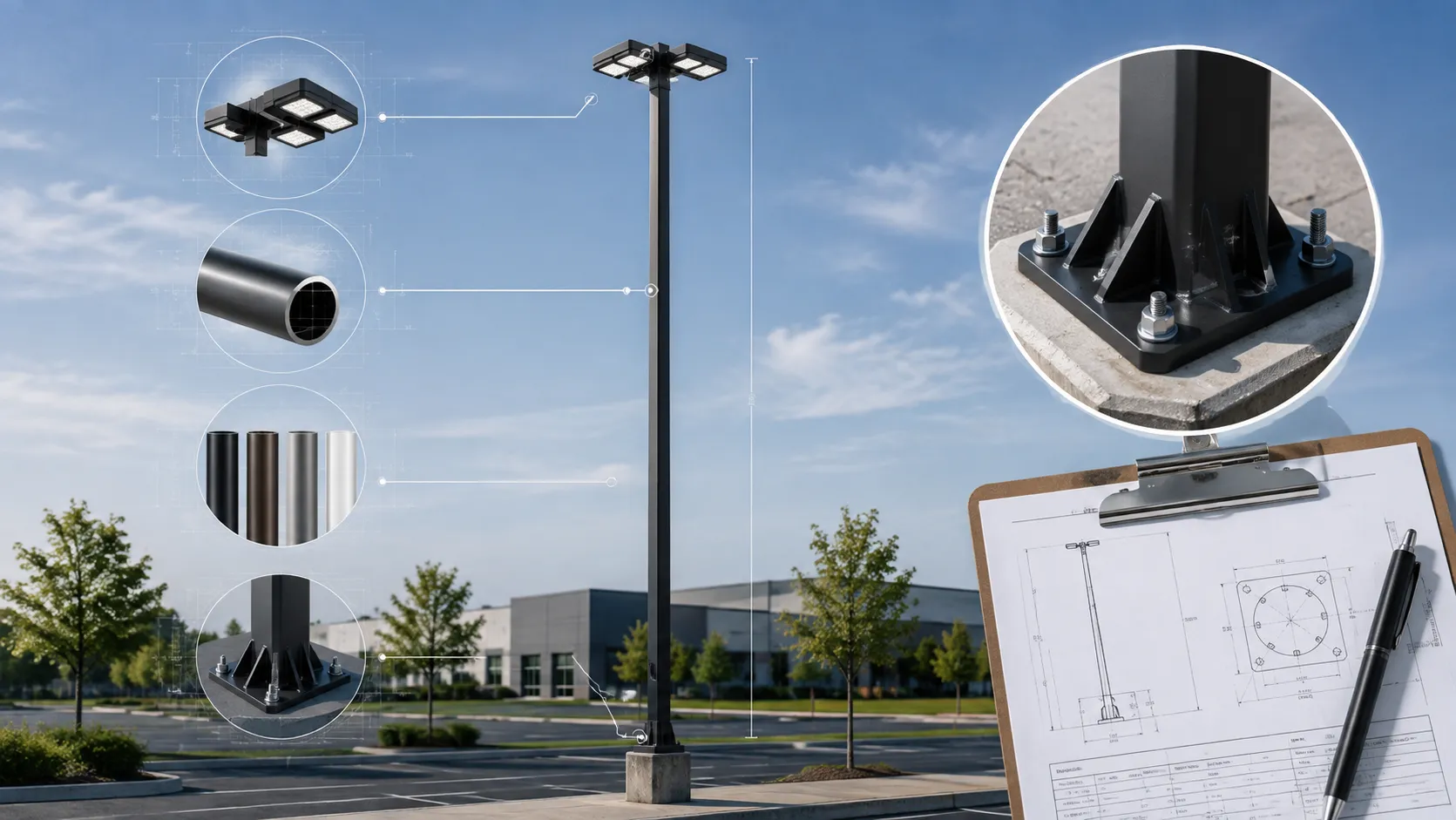
Ordering a light pole involves more than choosing a height and color. The correct pole needs to work with the lighting fixtures, mounting configuration, anchor bolt pattern, local wind conditions, and the requirements of the job site.
Providing the right information before the pole is ordered can help prevent compatibility problems, installation delays, unexpected modifications, and additional job-site costs.
At Light Pole Systems, we help contractors, facility teams, property managers, municipalities, and other commercial customers identify the specifications needed to order the right light pole for a new installation or replacement project.
Key Takeaways
Before ordering a light pole, be prepared to confirm:
- Pole height
- Installation location
- Steel or aluminum construction
- Pole size and shape
- Wall thickness or gauge, when applicable
- Fixture quantity, weight, and EPA
- Fixture mounting requirements
- Anchor bolt size and pattern
- Pole finish and color
- Any custom mounting or fabrication requirements
- Quantity, delivery location, and job-site freight considerations
If you do not know all of these specifications, that does not necessarily mean you need to figure everything out yourself. The installation location and fixture information can help determine many of the structural requirements.
What Information Do You Need to Order a Light Pole?
The information needed depends partly on whether you are replacing an existing pole or installing a completely new lighting system.
For most projects, start by gathering as much of the following information as possible.
| Specification | Why It Matters |
|---|---|
| Installation location | Helps determine applicable wind conditions and structural requirements |
| Pole height | Affects lighting layout, structural loading, and pole selection |
| Material | Determines whether steel or aluminum is appropriate |
| Pole size and shape | Determines physical configuration and compatibility |
| Wall thickness | Affects structural capacity |
| Fixture quantity | Affects total loading and mounting configuration |
| Fixture weight | Must remain within the pole’s rated capacity |
| Fixture EPA | Used with wind conditions to evaluate pole loading |
| Fixture mounting | Determines drilling, tenons, arms, bullhorns, or other mounting needs |
| Anchor bolt pattern | Critical when matching an existing foundation |
| Anchor bolt diameter | Must be compatible with the pole base plate and hardware |
| Finish and color | Affects appearance and corrosion protection |
| Delivery information | Pole length and quantity affect freight and unloading requirements |
Let’s look at each of these more closely.
1. Start With the Light Pole Installation Location
One of the first questions when ordering a light pole is:
Where will the pole be installed?
The project location matters because light poles are exposed structures. Wind conditions vary considerably by location, and the pole needs to be appropriate for the loads expected at the project site.
A pole that is appropriate for one installation may not necessarily be appropriate for another location simply because the height and fixture are the same.
When requesting a quote, provide the city, state, and ZIP code or the project address whenever possible.
The location can then be considered along with:
- Pole height
- Fixture weight
- Fixture EPA
- Number of fixtures
- Mounting configuration
- Applicable project specifications
Final pole selection should comply with the manufacturer’s load information, project requirements, applicable codes, and any required engineering criteria.
2. Determine the Required Light Pole Height
Light poles are available in many heights, and the correct height depends on the application.
Common applications include:
- Parking lots
- Commercial properties
- Roadways
- Walkways
- Schools
- Municipal facilities
- Industrial properties
- Parks
- Sports and recreational areas
If you are replacing an existing pole, measure or identify the existing pole height whenever possible.
For a new installation, pole height is generally selected as part of the overall lighting design so that the fixtures provide the desired light distribution while meeting structural and site requirements.
Do not select a pole based on height alone. A 20-foot pole, for example, can be manufactured in different materials, dimensions, wall thicknesses, and structural capacities.
3. Choose Between Steel and Aluminum
Another important specification is the pole material.
Commercial light poles are commonly manufactured from steel or aluminum.
Light Pole Systems offers several configurations, including:
- Square Straight Steel (SSS)
- Round Straight Steel (RSS)
- Round Tapered Steel (RTS)
- Round Straight Aluminum (RSA)
- Square Straight Aluminum (SSA)
The best material depends on the project environment, structural requirements, appearance, maintenance considerations, and project specifications.
For projects requiring a particular configuration, size, shape, or finish, learn more about our custom light poles.
Steel Light Poles
Steel poles are commonly used for commercial parking lots, roadway lighting, industrial properties, and other exterior applications requiring a durable structural pole.
Depending on the application, steel poles may be available with different wall thicknesses, shapes, finishes, and mounting configurations.
Aluminum Light Poles
Aluminum is another option for exterior lighting applications and may be preferred where corrosion resistance, weight, appearance, or project specifications make aluminum appropriate.
Neither material should be selected solely because one is assumed to be “stronger” or “better.” The complete pole specification and expected loading need to be considered.
4. Confirm the Pole Size, Shape, and Wall Thickness
After material and height, the physical dimensions of the pole need to be established.
Specifications may include:
- Square or round
- Straight or tapered
- Shaft diameter or width
- Wall thickness
- Steel gauge
- Base plate dimensions
For example, two square steel poles may look almost identical from a distance while having different wall thicknesses and completely different load capacities.
This becomes particularly important when fixtures are heavy, multiple fixtures are installed on one pole, or the project is located in an area with higher wind requirements.
If you are replacing an existing pole, do not assume that matching only the outside dimensions will produce an equivalent replacement.
5. Know the Fixture Quantity, Weight, and EPA
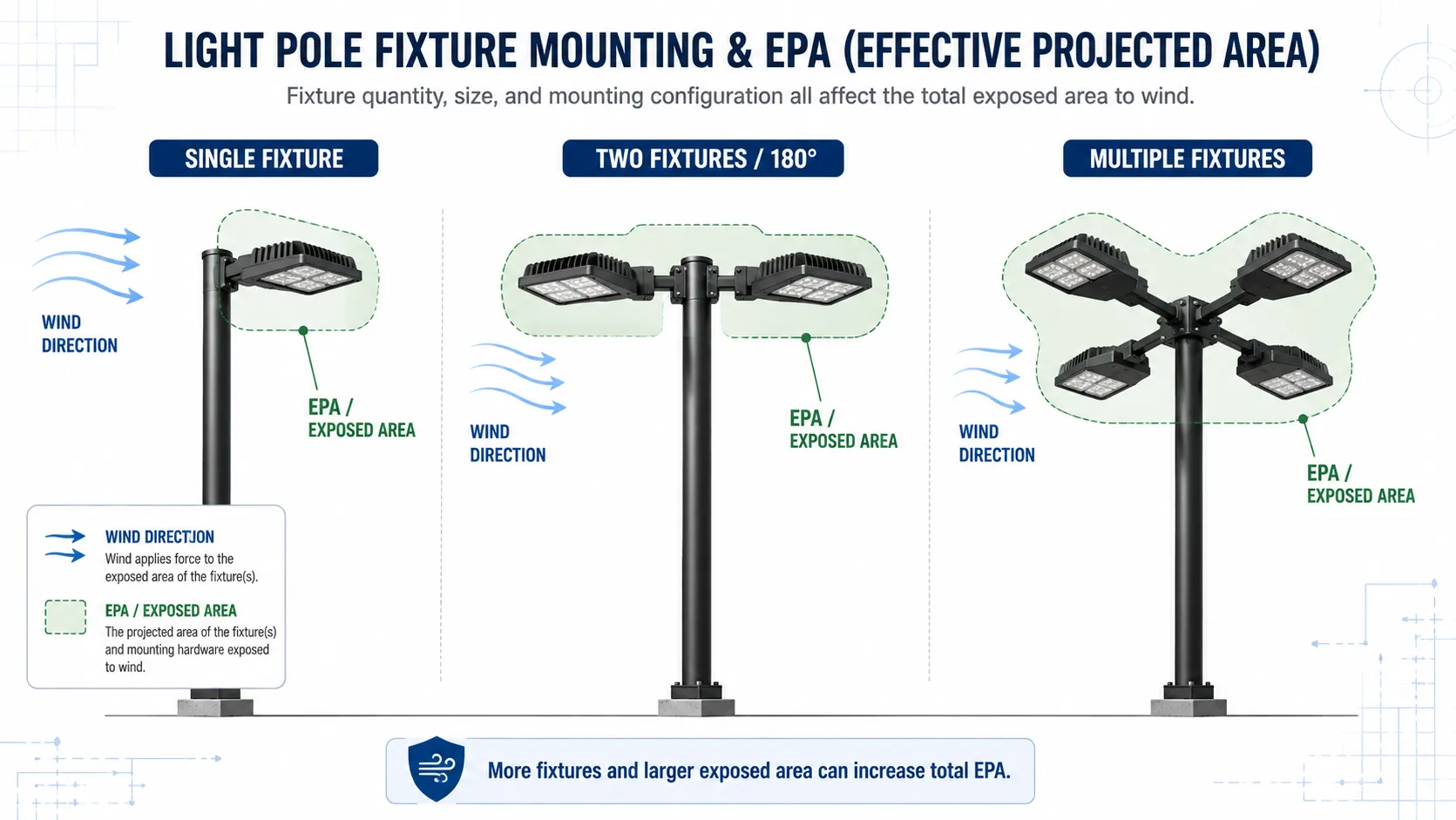
The light fixtures and other equipment mounted at the top of the pole are important factors in determining the correct light pole.
If possible, provide the fixture manufacturer and model number or the fixture specification sheet when requesting a pole.
Important fixture information includes:
- Number of fixtures per pole
- Weight of each fixture
- EPA of each fixture
- Fixture mounting configuration
- Weight and EPA of mounting arms, brackets, cameras, signs, or other pole-mounted equipment when applicable
What Is EPA?
EPA stands for Effective Projected Area. It represents the wind-loading effect created by a light fixture or other equipment mounted on the pole.
EPA is not the same as fixture weight. A fixture may be relatively lightweight while still presenting a significant area to the wind, so both EPA and actual fixture weight need to be considered when selecting a pole.
The pole’s allowable EPA can also change based on factors such as pole height, pole construction, fixture configuration, and the design wind conditions for the project location.
For a more detailed explanation of fixture EPA, maximum pole EPA, wind speed, and how to read pole load charts, see our guide to light pole EPA rating.
What If You Don’t Know the Fixture EPA?
Start with the fixture manufacturer’s specification sheet. Fixture manufacturers typically provide the EPA and weight for their products in the technical documentation.
If you already know the fixture manufacturer and model number, provide that information when requesting the pole. It can help identify the fixture specifications needed to evaluate the appropriate pole.
For multiple fixtures or other equipment mounted on the same pole, the complete configuration should be considered rather than evaluating only one fixture. All the information can make it much easier to identify the specifications needed for the pole.
6. Determine How the Fixtures Will Mount to the Pole
Do not wait until the pole arrives at the job site to figure out how the fixture will attach.
Fixture mounting should be identified when the pole is ordered.
Depending on the lighting system, mounting may involve:
- Direct side mounting
- Pre-drilled mounting holes
- Tenons
- Post-top mounting
- Fixture arms
- Bullhorns
- Tenon adapters
- Multiple-fixture configurations
There may also be additional custom requirements such as:
- Camera mounts
- Additional hand holes
- Specialty brackets
- Custom drilling
- Other pole-mounted equipment
Providing the fixture specifications during the ordering process allows mounting requirements to be addressed before the pole reaches the job site.
For examples of common mounting configurations, see our guide to light pole fixture mounting options.
That is generally much easier than discovering that the fixture and pole do not match while an installation crew and equipment are already waiting.
7. Measure the Existing Anchor Bolts for Replacement Poles
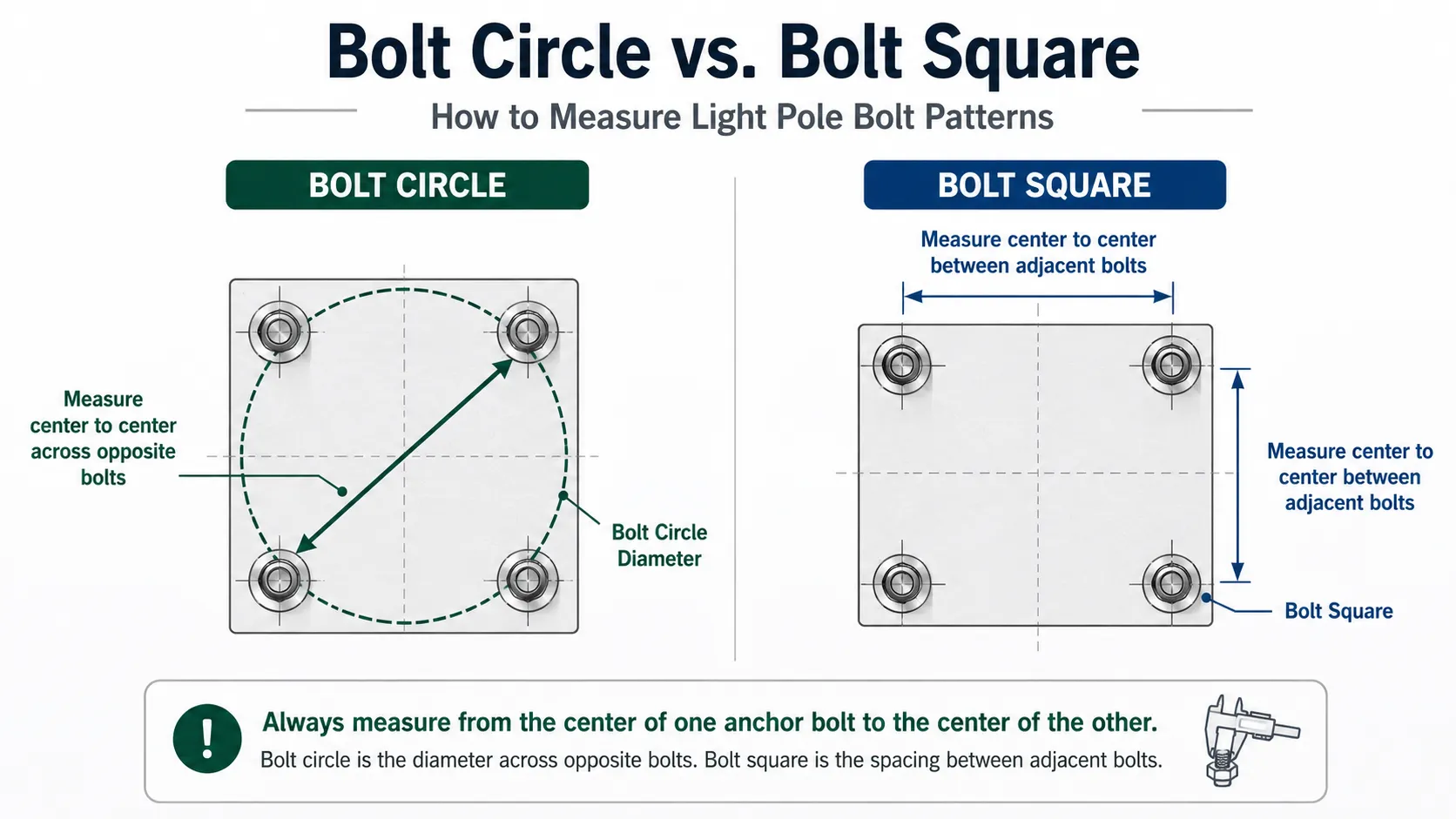
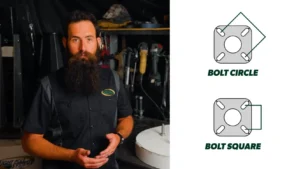
Bolt circle measures center to center across opposite anchor bolts, while bolt square measures center to center between adjacent bolts.
Watch: How to Measure a Light Pole Bolt Pattern
Not sure whether you have a bolt circle or bolt square measurement? This video demonstrates how to measure an existing light pole anchor bolt pattern so you can provide the correct dimensions when ordering a replacement pole.
For a replacement light pole, the existing foundation may determine many of the ordering requirements.
Before ordering, identify the:
- Anchor bolt diameter
- Number of anchor bolts
- Bolt pattern
- Bolt circle or bolt square
- Available usable thread
- Condition of the anchor bolts
One particularly common problem is confusing bolt circle with bolt square.
They are not the same measurement.
For a typical four-bolt pattern:
- Bolt circle is the diagonal measurement across opposing bolts and represents the diameter of the circle passing through the center of the bolts.
- Bolt square is the measurement between adjacent bolts forming one side of the square.
Mixing up these measurements can result in a new pole arriving with a base plate that does not match the existing foundation.
Whenever possible, confirm exactly which measurement the pole manufacturer requires.
For complete measurement instructions, see our guide to light pole bolt patterns, including bolt circle vs. bolt square.
8. What If the New Pole Does Not Match the Existing Anchor Bolts?
A mismatched bolt pattern does not automatically mean the entire concrete foundation must be demolished and replaced.
Depending on the pole, foundation, anchor bolt condition, and engineering requirements, an adjustment solution may be available.
Light Pole Systems manufactures an Anchor Bolt Adapter designed to address certain misalignment problems between existing anchor bolts and a light pole base plate.
The correct solution depends on the actual anchor bolt size, bolt pattern, required adjustment, pole height, fixture loading, and other project conditions.
It is much better to identify a bolt-pattern problem before ordering the replacement pole than after the pole has already been delivered.
9. Check the Condition of Existing Anchor Bolts
Measurements are only part of the equation.
When replacing a pole on an existing foundation, inspect the visible anchor bolts for signs of:
- Severe corrosion
- Damaged threads
- Bent anchor bolts
- Missing hardware
- Previous modifications
- Insufficient usable thread
- Other visible damage
The condition of the anchor bolts can affect whether they can be reused and what options may be available.
If leveling hardware is involved, our guide to light pole leveling nuts explains why accessing and evaluating this hardware can be important during pole work.
Do not assume an existing anchor bolt is suitable for reuse simply because it is still sticking out of the concrete.
10. Select the Pole Finish and Color
The pole finish affects both appearance and long-term protection.
Depending on the pole material and project requirements, options may include:
- Powder-coated finishes
- Galvanized finishes
- Painted finishes
- Standard colors
- Custom colors
When replacing one pole in an existing property, color matching may also be important.
A finish should not be selected based solely on appearance. Environmental exposure, corrosion concerns, maintenance expectations, and project specifications should also be considered.
For a closer comparison of common steel pole finishes, see powder coated vs. galvanized light poles.
If the project requires a particular architectural appearance, send photographs or finish information from the existing poles whenever possible.
11. Consider Drainage and the Pole Base Environment
The area around the base of the pole matters after installation.
Water, irrigation, soil, mulch, landscaping material, and debris can create conditions that contribute to corrosion around steel pole bases and mounting hardware.
The pole base should not be treated as an afterthought.
Our guide to light pole drainage and base corrosion explains why managing water around the foundation and pole base is an important part of long-term pole maintenance.
For a replacement project, photographs of the existing foundation can also provide useful information about the condition and environment in which the new pole will be installed.
12. Plan for Freight Before the Pole Is Ordered
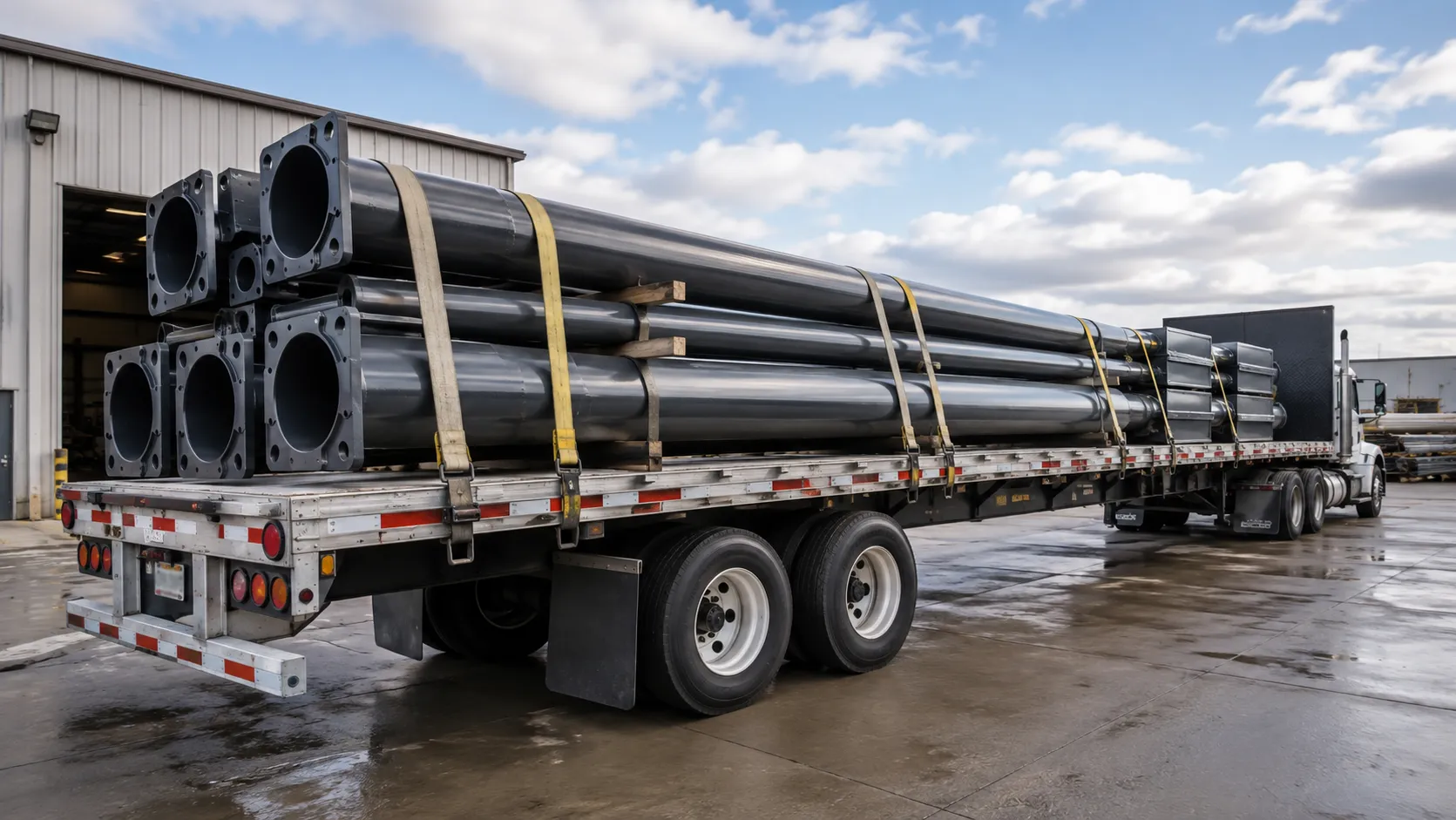
Because light poles are long and heavy, shipping them requires coordination beyond a typical parcel delivery.
Before finalizing an order, provide:
- Number of poles
- Pole lengths
- Delivery address and type of location
- Site access information
- Required delivery timeframe
- Any known unloading limitations
Light Pole Systems ships light poles across the country using dedicated hot shot carriers that transport the poles directly from our production facility to your job site or warehouse. This service costs more than traditional less-than-truckload (LTL) freight, but because the poles are handled less and travel directly to their destination, our pole damage and delivery delays are next to zero.
For larger projects, coordinating delivery with the installation schedule can help prevent poles from arriving too early, being stored improperly, or reaching the site before unloading equipment is available.
13. Make Sure the Job Site Can Receive the Delivery
Another frequently overlooked question is:
What happens when the truck arrives?
Before delivery, determine who will receive the poles and how they will be safely unloaded.
Depending on the shipment and project, appropriate material-handling or lifting equipment may be required.
The job site should have sufficient access for the delivery vehicle, and the receiving team should understand the unloading requirements before the shipment arrives.
If poles will be lifted or positioned as part of the project, review our light pole rigging safety guide as a general educational resource.
Rigging and lifting should be performed by qualified personnel using appropriate equipment, site-specific planning, and applicable safety requirements.
Ordering a Replacement Light Pole vs. a Pole for a New Installation
The ordering process changes slightly depending on the project.
For a Replacement Light Pole
Gather as much information as possible about the existing installation:
- Existing pole height
- Pole material
- Pole shape and dimensions
- Anchor bolt diameter
- Bolt pattern
- Fixture manufacturer and model
- Fixture mounting
- Existing pole color and finish
- Photographs of the pole and foundation
- Project location
The existing anchor bolts are particularly important if the intent is to reuse the existing concrete foundation.
For a New Light Pole Installation
For a new installation, the pole, fixture, foundation, and anchor bolts can be coordinated as part of the project specifications.
Provide:
- Project location
- Required pole height
- Fixture information
- Desired pole style
- Finish
- Quantity
- Project plans or specifications when available
- Required delivery schedule
Coordinating these details before the foundation is installed can help avoid compatibility problems later.
Common Light Pole Ordering Mistakes
A few mistakes create a disproportionate amount of trouble on light pole projects.
Ordering Based Only on Pole Height
Two poles of the same height can have very different structural capacities.
Height is only one specification.
Guessing the Anchor Bolt Pattern
A small error in the bolt pattern can prevent the pole from fitting the foundation.
Measure carefully and confirm whether the measurement is bolt circle or bolt square.
Ignoring Fixture EPA
Fixture weight alone does not provide enough information to evaluate wind loading.
Provide both fixture weight and EPA whenever available.
Waiting to Determine Fixture Mounting
Mounting modifications are much easier to address before the pole is fabricated and delivered.
Forgetting About Freight and Unloading
The pole may be correct in every technical detail and still create a job-site problem if nobody planned how it would arrive or be unloaded.
Assuming the Existing Hardware Is Reusable
Inspect existing anchor bolts and hardware before building the replacement order around them.
Light Pole Ordering Checklist
Before requesting a quote, gather as many of these items as possible:
- Project address or city, state, and ZIP code
- Quantity of poles
- Pole height
- Steel or aluminum preference
- Round or square pole
- Straight or tapered pole
- Pole dimensions
- Wall thickness or gauge, if known
- Fixture manufacturer and model number
- Number of fixtures per pole
- Fixture weight
- Fixture EPA
- Fixture mounting configuration
- Anchor bolt diameter
- Bolt circle or bolt square measurement
- Pole finish
- Pole color
- Custom mounting requirements
- Photographs of existing pole and foundation for replacement projects
- Delivery address
- Required delivery timeframe
- Job-site access or unloading considerations
Do not worry if every box cannot be checked.
The important thing is to provide the information you do have rather than guessing at specifications that may affect compatibility or structural requirements.
Don’t Know All the Light Pole Specifications? Start With the Location and Fixture
If you are unsure about the required pole strength, material, dimensions, or wall thickness, start with two pieces of information:
1. Where is the pole being installed?
The location helps establish the wind conditions and other project requirements that may affect pole selection.
2. What fixtures will be mounted on the pole?
Provide the fixture manufacturer, model, quantity, weight, EPA, and specification sheet whenever possible.
From there, the pole height, material, dimensions, structural capacity, and mounting configuration can be evaluated for the application.
For replacement projects, also send photographs and measurements of the existing pole, base plate, foundation, and anchor bolts.
Need Help Ordering a Light Pole?
Whether you are replacing a single damaged pole or planning a larger commercial lighting project, providing the correct specifications at the beginning can save considerable time at the job site.
Light Pole Systems can help review the information you have, identify missing specifications, and determine available light pole options for your application.
If you are not sure what to order, contact Light Pole Systems with your project location, fixture information, pole requirements, and any photographs or drawings you have available.
The more information we have before the pole is ordered, the easier it is to help make sure the pole arriving at the job site is the pole the project actually needs.