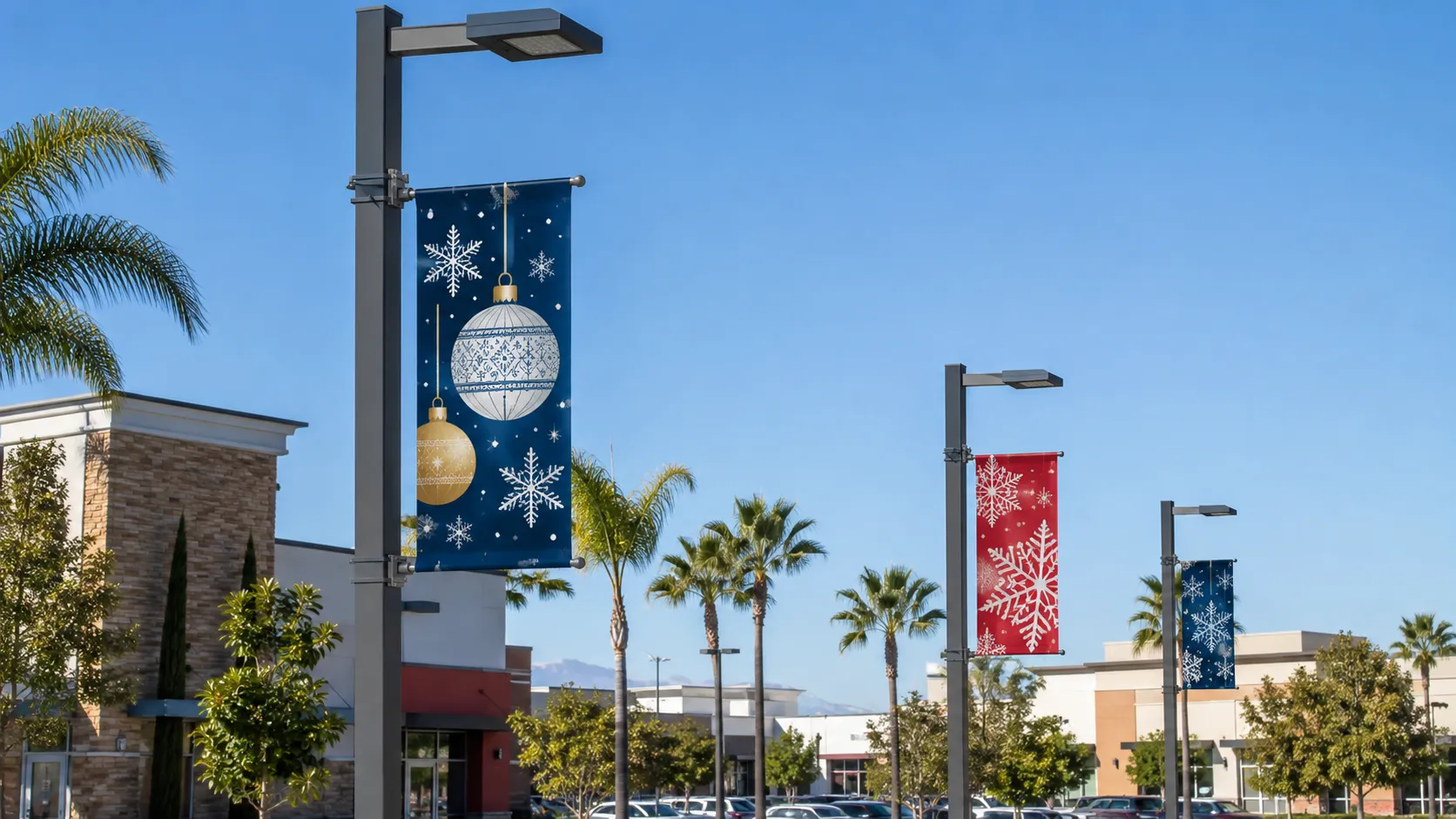
Holiday decorations, event banners, city banners, and promotional signs are commonly mounted to light poles. They may look relatively lightweight, but once wind is involved, a banner can place considerably more load on a pole than its weight alone would suggest.
Before installing banners on an existing light pole, it is important to understand how the additional surface area can affect wind loading and the pole’s overall capacity.
The key question is not simply, “Can the pole physically hold the banner?”
The better question is:
Was the light pole designed to handle the additional wind load created by the banner and mounting hardware?
Key Takeaways
- Banners add wind load to a light pole even though they may weigh very little.
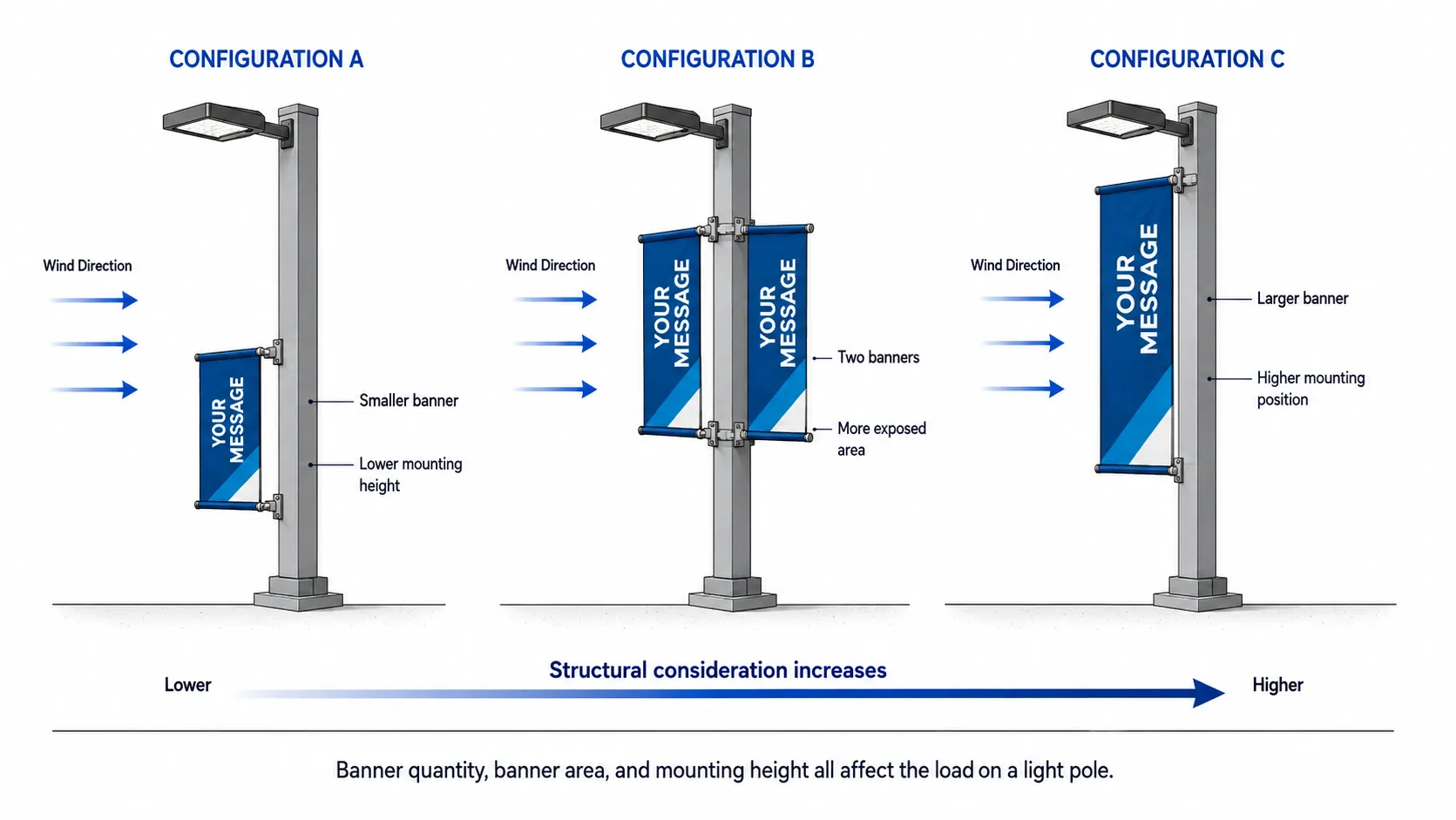
- Banner size, quantity, mounting height, orientation, and bracket design can all affect the load placed on the pole.
- The existing light fixtures already use part of the pole’s wind-load capacity.
- A pole’s published EPA rating should not automatically be treated as available capacity for adding banners.
- Larger banners, multiple banners, and banners mounted higher on the pole generally deserve greater scrutiny.
- The pole manufacturer, banner-system manufacturer, or a qualified engineer should verify that the complete configuration is appropriate before installation.
Why Banners Add Wind Load to a Light Pole
When wind strikes a banner, the banner acts as an additional surface exposed to that wind.
That wind pressure transfers through the banner brackets and into the light pole.
The effect becomes especially important when banners are:
- Large
- Installed in pairs
- Mounted high on the pole
- Attached with rigid brackets
- Installed on poles already carrying multiple light fixtures
- Located in areas exposed to strong or turbulent winds
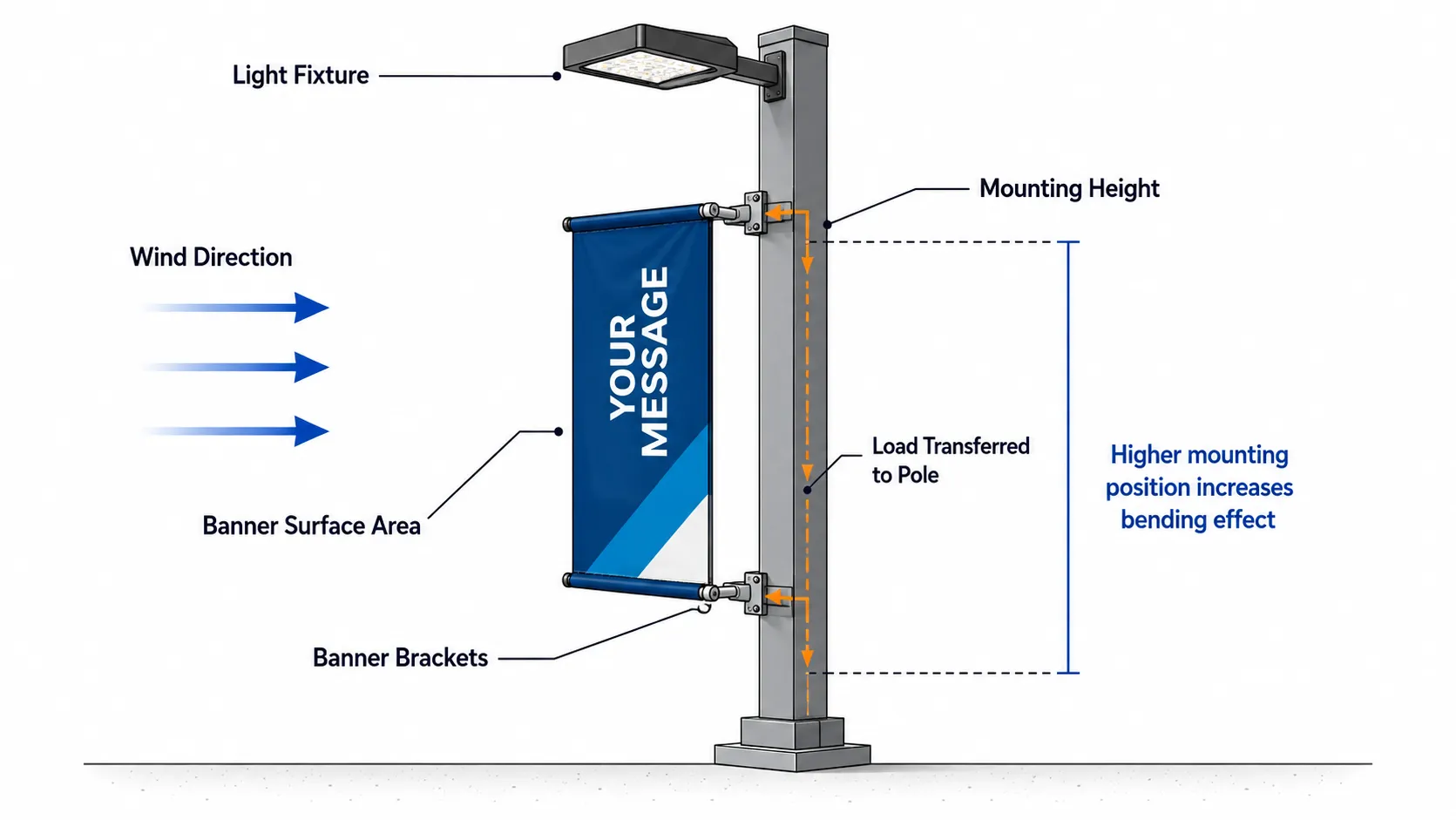
The banner itself may weigh only a few pounds, but its surface area and position on the pole can create substantially more structural demand than the banner’s weight would suggest.
This is why banner installations should be considered as part of the overall light pole configuration rather than treated as a decorative accessory with no structural effect.
What Does EPA Have to Do With Light Pole Banners?
EPA stands for Effective Projected Area.
EPA is commonly used when evaluating how lighting fixtures and other equipment mounted to a pole interact with wind.
Every light pole is designed for a particular combination of factors, including pole height, material, wall thickness, fixture configuration, wind conditions, and other engineering requirements.
The fixtures mounted at the top of the pole already contribute to the wind load.
Adding one or more banners changes that configuration.
If you are unfamiliar with EPA, start with our guide to light pole EPA ratings, which explains how fixture quantity, size, mounting configuration, and wind exposure affect light pole selection.
Banner Area and EPA Are Not Necessarily the Same Thing
A common mistake is assuming that the square footage of a banner can simply be compared directly with the remaining EPA listed for a pole.
Banner behavior is more complicated.
Unlike a rigid lighting fixture, a banner may flex, rotate, spill wind, or change shape depending on the banner material and mounting system.
Because of this, determining whether a banner is acceptable should be based on the complete banner and bracket configuration rather than banner dimensions alone.
Factors That Affect Light Pole Banner Wind Load
Several pieces of information should be considered before adding a banner system to an existing pole.
1. Banner Size
A larger banner generally presents more surface area to the wind.
Increasing either the width or height of the banner can therefore change the forces transferred to the pole.
Do not assume that a banner is acceptable simply because similar-sized banners are installed on another property. The poles, mounting height, fixtures, wind exposure, and engineering requirements may be completely different.
2. Number of Banners
Installing two banners instead of one changes the pole configuration again.
Multiple banners installed at different heights can add even more exposed area.
The complete installation should be evaluated as a system rather than considering each banner independently.
3. Mounting Height
Where the banner is installed on the pole matters.
Wind load applied higher on a pole generally creates a greater bending effect than the same load positioned closer to the base.
This is one reason banners mounted near the upper portion of a light pole should receive particular attention.
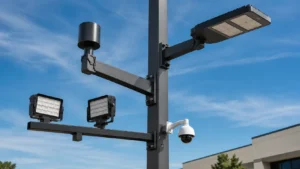
4. Existing Light Fixtures
The pole was originally selected to support a particular lighting configuration.
That may include:
- One fixture
- Two fixtures
- Multiple fixtures
- Tenons or mounting arms
- Cameras
- Signs
- Other pole-mounted equipment
All of those components contribute to the overall loading on the pole.
Before adding banners, determine what is already installed and obtain the fixture EPA and weight information whenever possible.
If you also need to document the existing fixture arrangement, see our guide to light pole fixture mounting options.
5. Banner Bracket Design
Not every banner bracket behaves the same way in wind.
Some systems use rigid arms, while others are designed to flex, rotate, break away, or allow the banner to change position as wind increases.
If a banner-system manufacturer provides tested wind-load or EPA information, that data is far more useful than estimating the load from the banner’s dimensions alone.
6. Local Wind Conditions
Wind conditions vary by location and site exposure.
An open parking lot, elevated site, coastal property, roadway, or other exposed location may experience different wind conditions than a protected site surrounded by buildings.
Local design requirements should therefore be considered when determining whether a particular banner installation is appropriate.
Do Wind Slits Make a Banner Safe for a Light Pole?
Wind slits or openings are sometimes added to banners with the intention of allowing air to pass through the material.
However, they should not be treated as proof that the banner produces an acceptable wind load.
The actual benefit can vary considerably depending on the banner design, amount of open area, material, wind speed, and mounting system.
Rather than assuming that a few wind slits solve the problem, obtain wind-load information from the banner or bracket manufacturer and verify that the light pole can accommodate the proposed configuration.
Flexible and Wind-Reducing Banner Brackets
Flexible or wind-responsive brackets can help reduce the amount of force transferred from a banner into a pole because the banner is allowed to move as wind increases.
That does not automatically mean every pole can safely support a banner.
The bracket system, banner dimensions, mounting height, number of banners, existing fixtures, pole specifications, and local wind conditions still need to be considered together.
Think of wind-reducing hardware as one part of the design, not a substitute for verifying the capacity of the pole.
What to Check Before Installing Banners on a Light Pole
Before mounting banners to an existing light pole, gather as much information as possible about both the pole and the proposed banner installation.
Light Pole Information
Identify:
- Pole manufacturer, if known
- Pole model or original drawings
- Pole height
- Pole material
- Shaft dimensions
- Wall thickness, if available
- Existing fixture quantity
- Fixture EPA
- Fixture weight
- Existing mounting arms or tenons
- Any other equipment already attached to the pole
Banner Information
Document:
- Banner width
- Banner height
- Number of banners per pole
- Mounting height
- Banner orientation
- Bracket type
- Whether brackets are rigid, flexible, or breakaway
- Wind-load or EPA information supplied by the banner-system manufacturer
The more complete this information is, the easier it becomes to determine whether the proposed configuration is appropriate.
Be Careful When Adding Banners to Existing or Older Poles
Extra caution is warranted when the original pole specifications are unavailable.
An older pole may also have experienced years of environmental exposure, vehicle impacts, corrosion, modifications, or previous loading conditions that are not obvious from a quick visual inspection.
If deterioration is visible, review our guide to light pole corrosion for common warning signs and failure risks.
Adding banners to a pole of unknown design should not be based solely on the fact that the pole has been standing for many years.
If the existing pole cannot accommodate the required banner and fixture configuration, a replacement pole may need to be selected specifically for the application.
Our guide on how to order a light pole explains the information that should be collected when selecting a replacement pole.
For projects requiring dimensions, configurations, materials, or engineering requirements that are not available from a standard pole, custom light poles may also be an option.
Plan for the Banner Before Ordering the Light Pole
If banners are part of a new project, the best time to account for them is before the poles are ordered.
Provide the pole supplier or manufacturer with the intended:
- Banner dimensions
- Number of banners
- Banner mounting height
- Bracket system
- Fixture quantity
- Fixture EPA
- Fixture weight
- Project location
That information allows the banner configuration to be considered when the pole is selected rather than added later as an unknown load.
For additional background on how pole construction and specifications affect the finished product, see how steel light poles are made.
This is much easier than discovering after installation that the existing pole was never designed for the additional banner load.
A Decorative Banner Can Become a Structural Consideration
Holiday banners and decorative pole-mounted signs may seem simple, but wind changes the equation.
The larger the banner, the more banners installed, and the higher they are mounted, the more important it becomes to understand how the complete configuration affects the pole.
Before installing banners:
- Identify the existing light pole.
- Confirm the light fixture configuration and EPA.
- Document the banner size and mounting height.
- Obtain wind-load information for the proposed banner and bracket system.
- Verify that the pole is appropriate for the complete configuration.
When the original pole specifications are unknown or the installation is unusual, consult the pole manufacturer or a qualified professional before proceeding.
If you are replacing a light pole or need help identifying the information required to select the right pole for a project, contact Light Pole Systems.