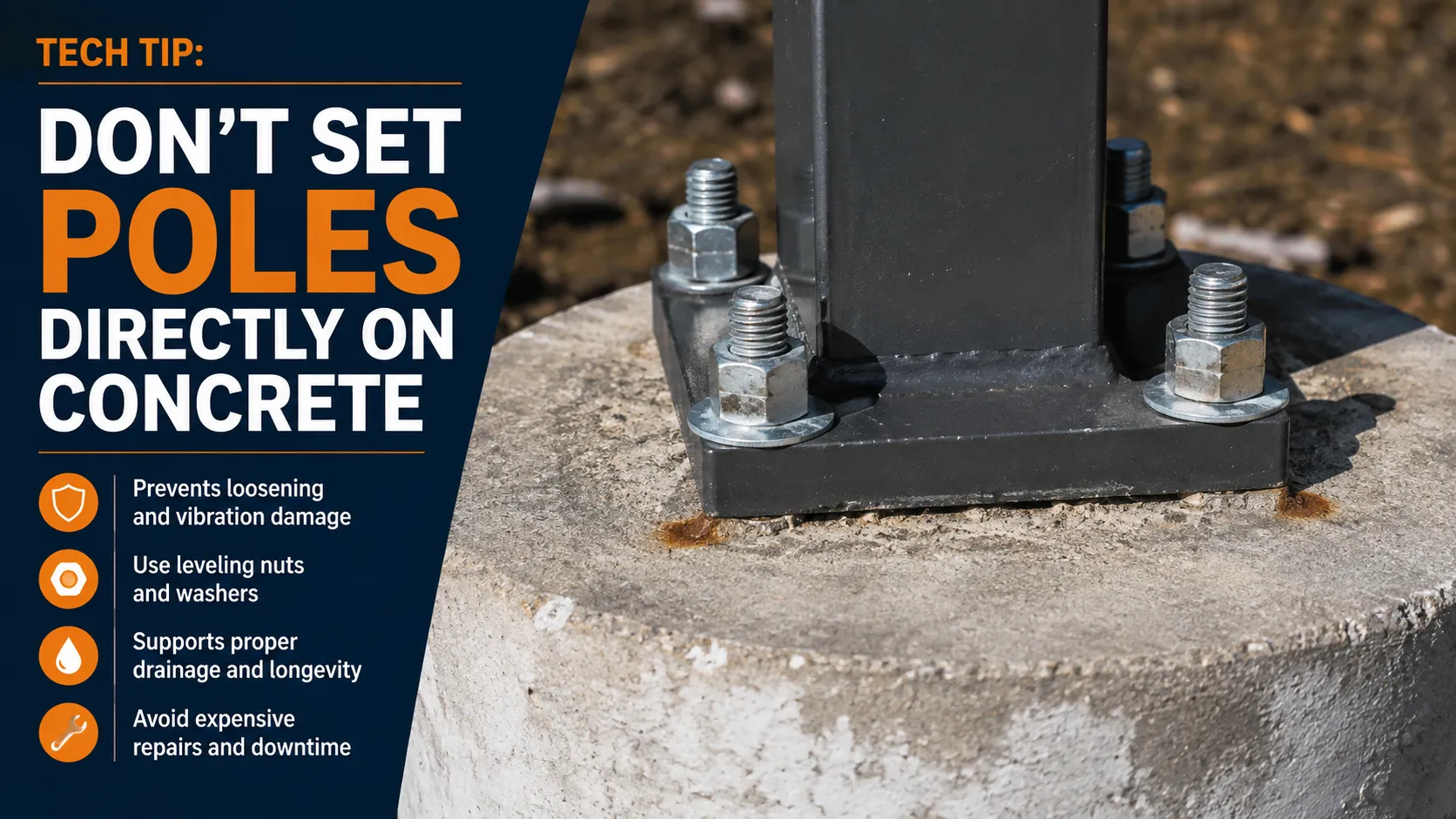
Proper light pole base plate installation requires more than simply placing the pole directly on top of a concrete footing and tightening the anchor bolts.
Even when the concrete surface appears smooth and level, a light pole base plate should not rely on direct contact with the concrete for proper support. Light poles move and vibrate slightly in the wind. Over time, that movement can wear against the concrete surface, allowing the installation hardware to loosen and potentially creating additional problems at the pole base.
A properly installed anchor-base light pole uses leveling nuts and washers below the base plate, with washers and top nuts securing the pole from above.
Key Takeaways
- Light pole base plates should not be set directly onto a concrete footing.
- Leveling nuts and washers should support the base plate from below.
- Top nuts and washers secure the base plate from above.
- Proper leveling hardware helps maintain a metal-to-metal connection at the anchor bolts.
- If existing anchor bolts are too short, Thread Extenders may provide additional usable thread in suitable applications.
- Retrofit anchor bolts should be drilled and epoxied into suitable existing concrete rather than relying on expanding anchors for this type of installation.
- Dry pack may make a properly installed pole appear as though the base plate is sitting directly on the concrete.
- Drainage around and below the light pole base is important when dry pack is present.
Why Light Pole Base Plates Should Not Sit Directly on Concrete
Light poles are exposed to wind and other environmental forces throughout their service life. Although the movement may not be noticeable when standing next to the pole, poles can vibrate and move slightly.
When a steel base plate is installed directly against a concrete footing, that repeated movement can gradually wear the surface of the concrete.
As the concrete beneath the base plate deteriorates, the pole may lose some of the firm support it had when originally installed. The top nuts can then become loose, allowing additional movement.
That creates a cycle:
- The pole moves.
- The base plate wears against the concrete.
- The concrete surface deteriorates.
- The mounting hardware can become loose.
- Additional movement can accelerate the problem.
For this reason, the concrete footing itself should not be used as a substitute for the proper leveling hardware beneath the pole.
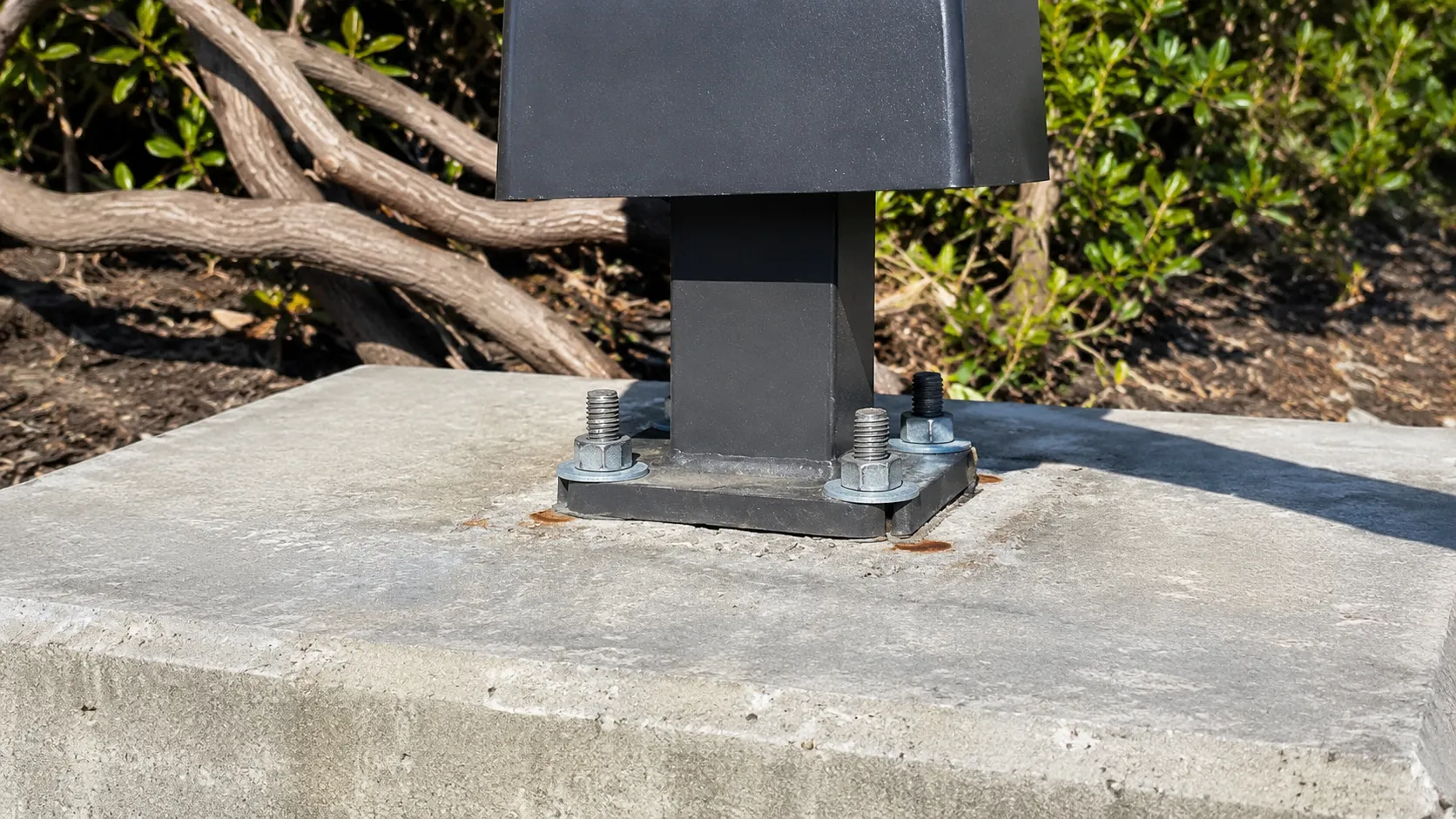
Proper Light Pole Base Plate Installation
A typical anchor-base light pole installation uses hardware both below and above the pole base plate.
From the concrete footing upward, the assembly generally includes:
- Anchor bolt
- Leveling nut
- Washer
- Light pole base plate
- Washer
- Top nut
The leveling nuts and washers beneath the pole support the base plate and allow the installer to adjust the pole before the upper hardware is tightened.
The top nuts and washers then secure the pole onto the anchor bolt assembly.
This configuration maintains a metal-to-metal connection through the mounting hardware rather than depending on the concrete surface beneath the base plate.
Why Leveling Nuts Matter
Leveling nuts do exactly what their name suggests: they allow the pole to be adjusted so it can be properly leveled during installation.
Instead of trying to compensate for small variations in the top of a concrete footing, the installer can make adjustments using the individual leveling nuts beneath the pole.
Once the pole is positioned correctly, the upper nuts and washers can be tightened.

If you are working with an existing pole where the leveling hardware has become difficult to reach, see our guide on how to access light pole leveling nuts.
What If the Existing Anchor Bolts Are Too Short?
Sometimes the existing anchor bolts do not project far enough above the concrete footing to provide sufficient usable thread for the leveling nuts, washers, pole base plate, and upper hardware.
This can occur because of the original anchor bolt installation, changes to the pole being installed, damage, corrosion, or other field conditions.
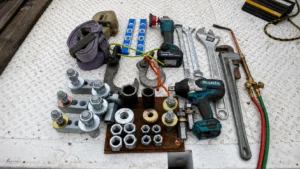
If the existing anchor bolts are otherwise suitable for reuse but do not have enough exposed usable thread, Light Pole Systems Thread Extenders are designed to provide additional usable thread for mounting a light pole.
Before selecting any repair or extension method, the existing anchor bolts and footing should be evaluated for the specific installation.
If you are unsure of the existing anchor bolt diameter, see our guide on how to measure light pole anchor bolt size.
Avoid Expanding Anchors for Retrofit Light Pole Anchor Bolts
When new anchor bolts need to be added to an existing concrete footing, expanding anchors such as Red Head-style anchors should not simply be treated as a replacement for a properly designed light pole anchor bolt installation.
For retrofit installations, new anchor bolts should instead be drilled into the existing footing and installed using an appropriate structural anchoring adhesive or epoxy system. Expanding anchors can come loose over time as the light pole moves and vibrates.
The concrete footing, anchor layout, anchor size, embedment, spacing, edge distances, adhesive system, and other project requirements must all be appropriate for the installation.
For a detailed overview of the process, see:
How to Install Anchor Bolts in an Existing Concrete Footing
That guide covers the general process of inspecting the footing, laying out the new anchor bolt locations, drilling the concrete, cleaning the holes, installing structural anchoring adhesive, and setting new threaded rods.
All Thread Rod and Epoxy Kits
Light Pole Systems is also developing its AT.75 and AT1 All Thread Rod and Epoxy Kits for 3/4-inch and 1-inch anchor bolt applications.
These kits are intended to provide a more complete solution for suitable retrofit anchor bolt installations. Refer to the latest product information and engineering documentation before specifying or installing these products.
Why Some Poles Look Like They Sit Directly on the Concrete
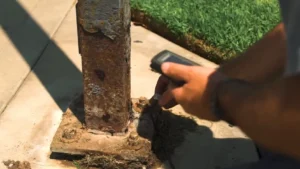
There is an important distinction between a pole whose base plate is actually sitting directly on the concrete footing and a pole that has been properly installed on leveling nuts but later has material placed beneath the base plate.
Many light poles that appear to sit directly against the footing are actually supported by leveling nuts.
After the pole has been installed and leveled, dry pack may be placed beneath or around the base plate.
From the outside, the finished installation can make it appear that the pole base plate was installed directly onto the concrete when the leveling hardware is actually underneath.

Dry Pack and Light Pole Drainage
Dry pack around a light pole base creates another consideration: water drainage.
Water and condensation need a way to escape from around the pole base. If material beneath or around the base plate prevents drainage, moisture can remain trapped at the bottom of the pole.
For existing installations, inspect the area around the base plate and determine whether water has an adequate drainage path.
For more information, read our Tech Tip on light pole drainage and base corrosion.
That article explains why drainage around a light pole base matters and what to look for when dry pack or other material is present around the base plate.
Signs a Light Pole Base Installation Needs Further Evaluation
When inspecting an existing light pole, pay attention to the condition of both the base plate and the mounting hardware.
Conditions that may require additional evaluation include:
- Missing leveling nuts or washers
- Loose top nuts
- Insufficient exposed anchor bolt thread
- Damaged or heavily corroded anchor bolts
- If corrosion is preventing access to the existing hardware, see our guide to removing rusted anchor nuts from light pole anchor bolts.
- Deteriorated concrete around the base plate
- Cracking or spalling around the concrete footing
- Heavy corrosion around the bottom of the pole
- Dry pack without an obvious drainage path
- A pole that appears out of level
- Visible movement at the base
- Damaged or missing mounting hardware
The correct solution depends on the actual condition of the pole, anchor bolts, base plate, and concrete footing.
Some problems may be addressed with existing hardware or specialized products, while other conditions may require new anchor bolts, pole replacement, footing work, or project-specific engineering.
Don’t Assume the Existing Installation Is Correct
One of the easiest mistakes to make when replacing a light pole is assuming that the existing installation should simply be duplicated.
Before installing a replacement pole, inspect the existing base and confirm:
- Anchor bolt diameter
- Usable exposed thread
- Anchor bolt condition
- Bolt pattern
- Leveling hardware
- Base plate condition
- Concrete footing condition
- Drainage around the pole base
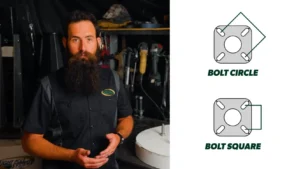
If you are unsure how the existing foundation should be measured, see our guide to light pole bolt patterns, including bolt circle vs. bolt square.
Before selecting a replacement pole, review how to order a light pole so the existing foundation, fixture, mounting, and project requirements can be documented correctly.
If the new light pole does not match the existing anchor bolt pattern, an Anchor Bolt Adapter may provide another solution for suitable installations.
You can also review our guide to 3 common light pole problems and how to prevent them before ordering or installing a replacement pole.
The Bottom Line on Light Pole Base Plate Installation
A light pole base plate should not simply be placed directly onto a concrete footing and tightened down.
Proper installation uses leveling nuts and washers below the base plate, with washers and top nuts above the plate. This allows the pole to be leveled while maintaining the hardware connection needed to support and secure the pole.
When existing anchor bolts are too short, damaged, incorrectly positioned, or otherwise unsuitable for the replacement pole, additional solutions may be available without automatically replacing the entire footing.
Depending on the situation, those solutions can include Thread Extenders, an Anchor Bolt Adapter, or new anchor bolts installed into an existing concrete footing.
The important part is identifying the actual problem before choosing the solution.
Need Help With a Light Pole Anchor Bolt or Base Plate Problem?
Every existing light pole installation is a little different. Anchor bolt size, bolt pattern, usable thread, footing condition, and pole base dimensions can all affect which solution is appropriate.
Light Pole Systems specializes in products designed to solve common light pole installation and repair problems.
Contact Light Pole Systems if you need help determining which product may be appropriate for your light pole project.